


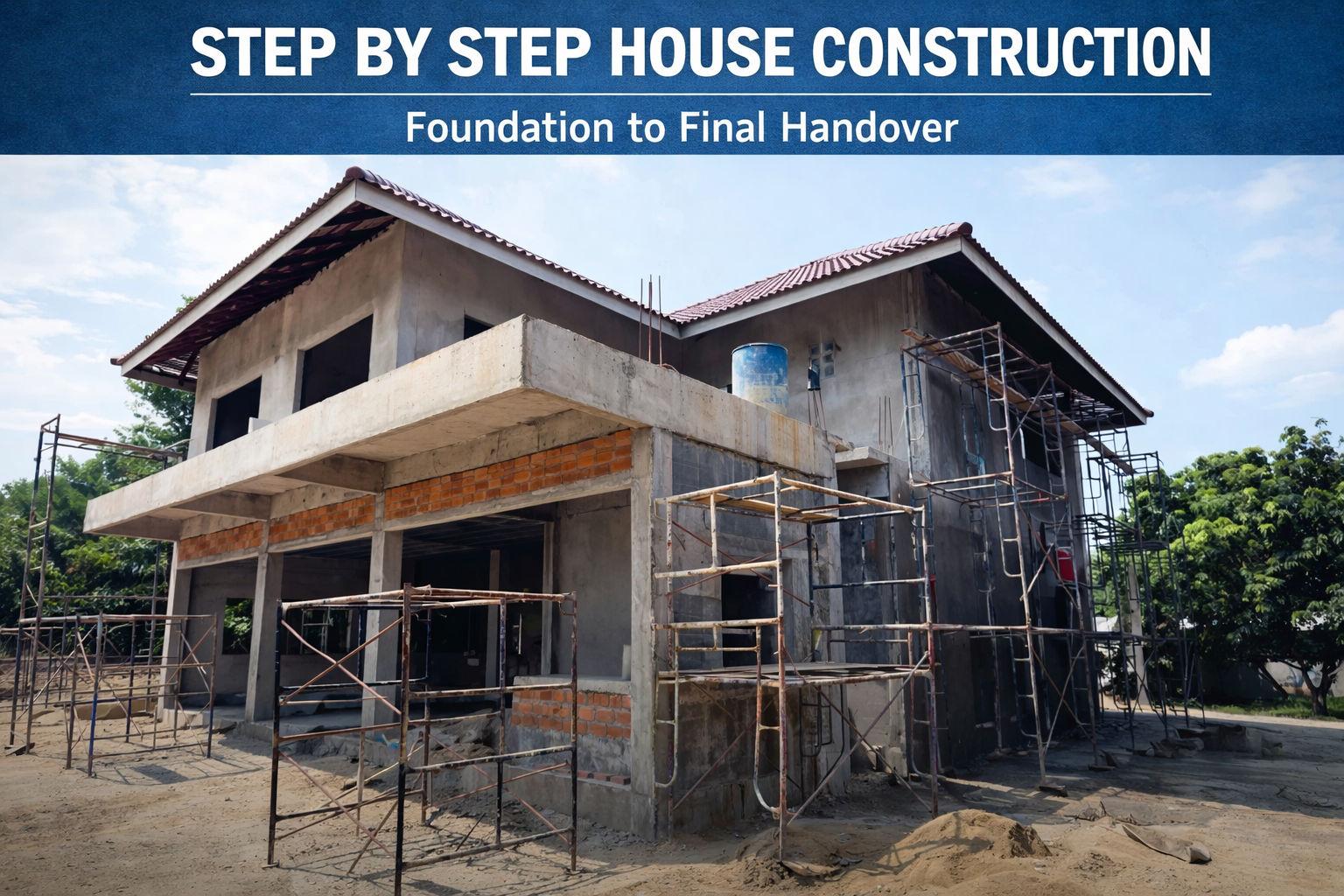
Building a house is probably the biggest project you'll ever take on. It's exciting, a little overwhelming, and full of decisions that matter. The good news? Once you understand how the house construction process actually works, it stops feeling like a mystery.
This guide walks you through every stage of house construction in plain language, so you know exactly what's happening at each step and what to expect.
What is the House Construction Process?
At its core, building a house means turning a blueprint into a real, liveable structure. But it's a lot more than just laying bricks. It involves land, legal paperwork, engineering decisions, and materials like TMT bars, fly ash bricks, cement bricks, and cement mixer machines, plus dozens of tradespeople working in sequence.
The entire process is split into three broad phases: pre-construction, construction, and post-construction. Let's go through each one.
Pre-Construction Phase: Laying the Groundwork
Before a single brick is placed, there's a lot of work to do on paper and on the ground.
1. Building Plan
Your building plan is the backbone of the entire project. Work with a licensed architect and structural engineer to create detailed drawings covering the floor plan, structural layout, site plan, elevation views, and terrace design.
This plan is not just for you, it's what contractors follow on-site and what local authorities need before they approve construction.
2. Budget Estimation
Once the plan is ready, a quantity surveyor or project estimator breaks it down into costs. Materials, labour, equipment like cement mixer machines, transport, and permits all get factored in.
Be thorough here. A realistic budget prevents nasty surprises mid-build. If needed, this is also the stage to approach a bank or housing finance company for a construction loan.
3. Land Acquisition
Good land is non-negotiable. Consider location, plot size, soil quality, access to roads, and proximity to utilities like water and electricity. Urban plots cost more but reduce infrastructure headaches. Outskirts plots offer space at a lower price but may require more groundwork.
4. Documentation
This step trips up many first-time builders. You need a range of documents before work can legally begin: a land title deed, building plan approval, structural stability certificate, NOCs from electricity, water, and fire departments, and more.
Missing paperwork can lead to construction being halted or, in worst cases, demolition orders. Get this sorted before any digging starts.
House Construction Process: Phase by Phase on Site
Once the pre-construction phase is complete, the physical work begins.
Step 1: Site Clearing
The site is cleared of trees, old structures, rocks, and debris. This gives workers a clean canvas. Heavy equipment like bulldozers or excavators are typically used depending on the size and state of the plot.
Step 2: Excavation and Foundation
Excavation means digging into the ground to the depth required by your structural plan. The depth depends on soil type, building load, and local conditions.
Then comes the foundation, which is literally what your home stands on. Concrete or stone is used to create a base strong enough to carry the entire weight of the structure above. A weak foundation is the one mistake that can never really be fixed later.
Anti-termite treatment and waterproofing are also done at this stage.
Step 3: Plinth Beam and Ground Slab
The plinth beam is a reinforced concrete beam that runs along the base of the walls, acting as a protective barrier between the foundation and the superstructure. It prevents cracks caused by soil movement and distributes load evenly.
Waterproofing at plinth level is critical, especially in flood-prone or high-moisture areas.
Step 4: Superstructure (Columns, Beams, and Slabs)
This is where the skeleton of your house takes shape. Columns go up, beams span across them, and floor slabs are cast on top. TMT bars (Thermo-Mechanically Treated steel bars) are used as reinforcement inside the concrete, giving the structure the tensile strength it needs to handle loads and resist earthquakes.
A cement mixer machine is essential here to ensure uniform concrete mixing. Manual mixing often leads to inconsistent strength in the final concrete, which can cause cracks over time.
Step 5: Bricklaying
With the structural frame in place, walls are constructed using bricks bonded with cement mortar. This is the stage where rooms actually start taking shape and you can physically walk through your future home.
Door and window openings are carved out as per the plan at this stage.
Step 6: Lintels and Roof Slab
Lintels are horizontal beams of concrete or steel placed above door and window openings to carry the load of the wall above them. Without a lintel, the weight above an opening can cause the wall to crack or collapse.
The roof slab is cast next using reinforced concrete, completing the main shell of the building.
Step 7: Plumbing and Electrical Wiring
Modern homes use concealed plumbing and wiring, meaning pipes and conduits are embedded inside the walls before plastering. This keeps the house looking clean and also protects the wires from heat, moisture, and rodents.
The sewage pipe must always run below the drinking water pipe to avoid contamination. Plan the electrical board and switch positions carefully at this stage since changes are expensive once the walls are plastered.
Step 8: Exterior and Interior Plastering
Once the wiring and plumbing are in place, the walls are plastered inside and out. Plastering smooths the surface, adds strength to the structure, and gives it protection against weather. For exterior walls, waterproof plaster compounds are often used.
Step 9: Flooring
Flooring goes in near the end of construction. Options range from ceramic tiles and vitrified tiles to Italian marble, granite, hardwood, and epoxy. Your choice depends on budget, space usage, and maintenance preferences.
What Materials Matter Most and Why
One thing most construction guides skip: the quality of materials directly impacts how long your home lasts and how much you'll spend on repairs over time. Here's a quick breakdown of the key materials used at different stages.
Fly Ash Brick vs Cement Brick: Which Should You Use?
Two of the most commonly used wall materials today are fly ash bricks and cement bricks, and many homeowners aren't sure which to pick.
Fly ash bricks**** are made from fly ash (a byproduct of coal combustion), cement, sand, and water. They are lighter than traditional red clay bricks, have low water absorption, and are more uniform in size. This makes them easier to work with and reduces the amount of mortar needed. Fly ash bricks also have good compressive strength and are considered more eco-friendly.
Cement bricks**** (also called concrete bricks) are made from cement, sand, and aggregates. They are denser and heavier than fly ash bricks, which gives them higher compressive strength. They are ideal for load-bearing walls, boundary walls, and areas where maximum strength is needed. However, they are slightly more expensive and heavier to work with.
For interior partition walls, fly ash bricks are usually the better choice for their light weight and lower cost. For exterior walls and structural applications, cement bricks or red clay bricks offer greater durability.
TMT Bars
TMT bars should meet IS 1786 standards. Low-grade bars may look identical but offer significantly less strength. Never compromise on TMT bar quality, it's what holds your columns, beams, and slabs together.
Bitumen for Waterproofing
Bitumen is used for waterproofing in foundations, roofs, and basement slabs. It forms a flexible, moisture-resistant layer that prevents water from seeping in over time. Good waterproofing at the plinth and roof level is one of the best long-term investments you can make in a house.
Cement Mixer Machine
For any build beyond very small extensions, a cement mixer machine is essential. It ensures a consistent, uniform concrete mix throughout. Inconsistent mixing by hand is one of the leading causes of structural cracks in residential buildings.
Post-Construction Phase: The Final Checks
Quality Inspection
Before handing the keys over, a thorough walkthrough is done to catch any defects: cracks, uneven surfaces, leaking pipes, faulty electrical connections. Minor issues are fixed at this stage.
Interior Work and Painting
False ceilings, cabinetry, kitchen fittings, and finish carpentry come in during the interior work phase. Painting is the last step, both inside and out. Exterior paints are weather-resistant and protect walls from rain and sunlight. Interior paints can be chosen for finish based on preference.
Handover
Once all checks are complete and regulatory certificates like the Occupancy Certificate and Completion Certificate are obtained, the house is officially handed over. Make sure you get all documents, warranties, and instructions from your contractor.
Common Mistakes to Avoid During House Construction
A few things that catch people off guard:
• Skipping soil testing before foundation design is a costly mistake. Different soil types require different foundation approaches.
• Underestimating the budget is nearly universal. Always keep a contingency fund of at least 10 to 15 percent above your estimated budget.
• Not supervising regularly leads to poor workmanship going unnoticed. Visit the site often, especially during foundation and structural stages.
• Choosing the wrong contractor based on cost alone can compromise the entire project. Check references, past work, and licensing.
Frequently Asked Questions
How long does the house construction process take?
The timeline depends on size, complexity, and material availability. A modest single-story home typically takes 6 to 12 months. Larger or multi-story homes can take 18 to 24 months.
What is the difference between fly ash brick and cement brick?
Fly ash bricks are lighter, more uniform, and eco-friendly, making them great for partition walls. Cement bricks are denser and stronger, making them better suited for load-bearing and exterior walls. The right choice depends on where in the structure the bricks are being used.
What is the role of TMT bars in house construction?
TMT bars provide tensile strength to reinforced concrete structures. They allow beams, columns, and slabs to handle loads without cracking. IS 1786-grade TMT bars are the standard specification for residential construction in India.
Why is bitumen used in construction?
Bitumen is a waterproofing material applied to roofs, foundations, and basements. It creates a flexible, moisture-resistant barrier that protects the structure from water ingress over time.
What is a plinth beam and why is it important?
A plinth beam is a reinforced concrete beam at the base of the walls. It protects the structure from soil movement, distributes load evenly, and prevents cracks from forming between the foundation and the wall.
Do I need a cement mixer machine for home construction?
For any build beyond very small extensions, yes. A cement mixer machine ensures a consistent, uniform concrete mix. Inconsistent mixing by hand leads to variations in concrete strength, which can result in cracks or structural weakness over time.
Building a house the right way takes patience, planning, and the right people. But when you understand the complete house construction process from pre-construction through to handover, including the right materials like fly ash bricks, cement bricks, TMT bars, bitumen, and using a cement mixer machine, you're in a much stronger position to make good decisions, catch problems early, and end up with a home that's safe, strong, and built to last.