


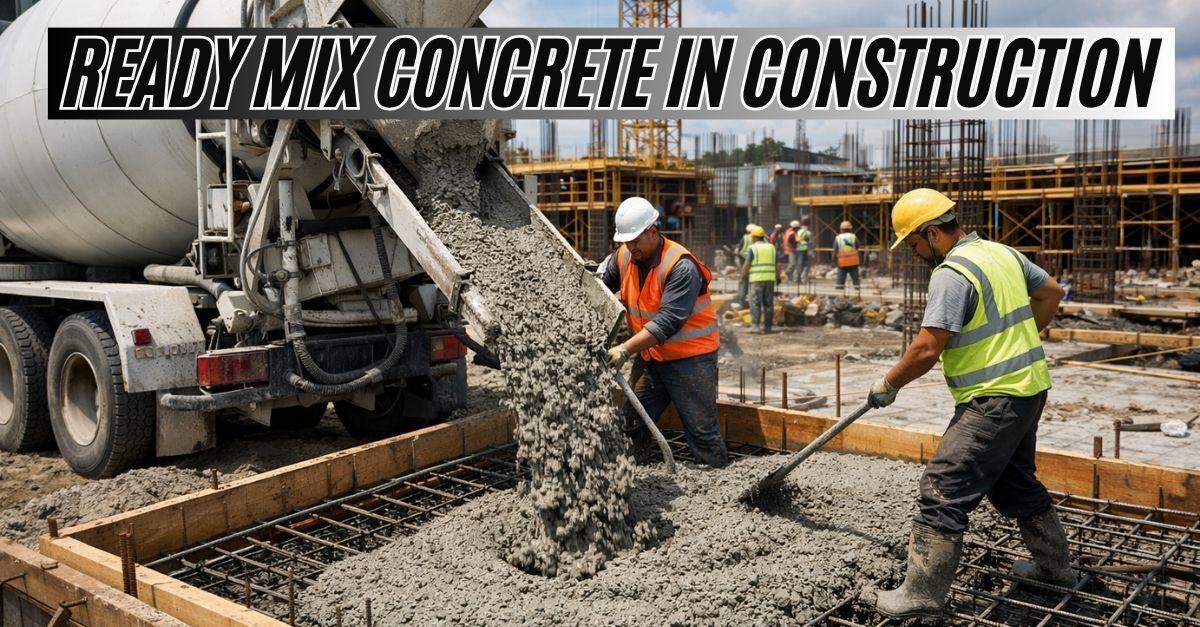
 What Is RMC? Meaning, Full Form, Uses and Benefits Explained
If you have ever built a house or been on a construction site, chances are someone mentioned RMC. But what exactly is it, why does it matter, and is it really better than mixing concrete the old-fashioned way?
In this guide, we break down everything you need to know about Ready-Mix Concrete (RMC) in plain language. From the full form and types to grades, pricing, and what actually happens on site, this is the only RMC explainer you will need.
RMC Full Form and What It Actually Means
RMC stands for Ready-Mix Concrete. As the name suggests, it is concrete that is mixed and prepared in a batching plant and then transported to the construction site ready to use.
But there is more to it than just convenience. RMC is essentially pre-engineered concrete. Every ingredient is weighed digitally, adjusted for moisture content, and mixed under controlled factory conditions. Instead of relying on a worker's judgement on site, you are relying on a calibrated system.
That shift from human guesswork to process control is the real value of RMC.
How Is RMC Produced? The Real Process
Here is what actually happens when RMC is made:
• Cement, sand, aggregates, and admixtures are loaded into the batching plant
• Materials are measured by weight (not by volume, which is far more accurate)
• Water is adjusted based on how much moisture the aggregates already carry
• The mix is blended under controlled conditions
• The ready concrete is loaded into a transit mixer truck
• The drum rotates continuously during transport to keep the mix from setting
Once RMC reaches your site, you have a working window of roughly 2 to 3 hours. After that, workability drops and you risk a weakened pour. This is why timing and coordination between the plant and site matter so much.
Types of Ready-Mix Concrete
Not all RMC is produced the same way. There are three main types based on how and where mixing happens:
1. Transit Mixed Concrete
Also called dry-batched or truck-mixed concrete. All raw materials including water are loaded into the truck mixer at the plant, and the drum does the actual mixing during transit. This is the most common type you will see on Indian construction sites.
2. Central Mixed Concrete
Here, the concrete is fully mixed at the plant before loading. The transit mixer drum then acts as an agitator during transport to keep the mix consistent. This gives you better quality control and is ideal for projects where mix precision is critical.
3. Shrink Mixed Concrete
This is a hybrid approach. The mix is partially done at the plant, and the remaining mixing is completed inside the transit drum either during transport or on arrival at site. It reduces the load on the plant while still maintaining reasonable consistency.
Where Is RMC Used in Construction?
RMC is not just for big infrastructure projects. Here is where it gets used across different types of construction:
• Residential buildings: Slabs, columns, beams, and foundations in homes and apartments
• Commercial projects: Office buildings, shopping complexes, warehouses, and factories
• Infrastructure: Roads, highways, flyovers, bridges, and tunnels
• Water structures: Dams, reservoirs, canals, and marine applications like ports and seawalls
• Mass construction: Stadiums, metro projects, airports, and precast elements
• Decorative work: Stamped, stained, or polished concrete for flooring and surfaces
• Repair and maintenance: Patching cracks, resurfacing, and reinforcing existing structures
For most Indian residential construction (G+1 or G+2 houses), RMC is the go-to choice for slabs, beams, and columns because of the consistency it brings.
RMC Grades for Residential and Commercial Construction
Concrete grades are defined by their compressive strength after 28 days of curing. The right grade depends on what you are building, not just picking the highest number.
| Grade | Strength (MPa) | Best Used For |
|---|---|---|
| M20 | 20 MPa | PCC, base concrete |
| M25 | 25 MPa | Slabs, beams |
| M30 | 30 MPa | Columns, foundations |
| M40 | 40 MPa | Bridges, high-rise buildings |
For a typical Indian home:
• M25 works well for slabs and beams
• M30 is better for columns and foundations where load is higher
• Going beyond M30 without a structural design only increases your cost without adding real-world benefit
Understanding Slump and Why You Should Never Add Water on Site
Slump is a measure of how workable or fluid the concrete is. For residential slabs, a slump of 100 to 150 mm is standard, especially when concrete is being pumped.
Here is the issue. The concrete sometimes arrives slightly stiff. Someone on site says "add a little water." It feels like a harmless fix. But it is not.
Adding water changes the water-cement ratio, which is the single most important factor controlling concrete strength. A small increase in water can reduce compressive strength by 10 to 20 percent. That is not a minor difference.
If you need more workability, always ask for a higher slump at the order stage. Workability adjustments should be done using admixtures at the plant, not with a garden hose on site.
What Actually Determines Concrete Strength After Pouring
RMC gives you a well-mixed, accurate concrete. But strength is not just about the mix. There are four pillars of concrete performance:
• Water-cement ratio: Controlled at the batching plant. Lower is generally stronger.
• Material quality: The quality of cement, sand, and aggregates used in the mix.
• Compaction: Proper use of vibrators to remove air pockets after pouring.
• Curing: Keeping the concrete moist so hydration continues and strength develops.
RMC does the first two very well. But compaction and curing are entirely in your hands on site. This is where most construction failures actually begin, not at the batching plant.
Curing: The Step Most Builders Underestimate
This one step decides whether your concrete performs at M25 or behaves like M15.
Concrete does not gain strength during mixing or pouring. It gains strength during curing, which is the process of keeping the concrete moist so the cement can continue to hydrate and harden properly.
What good curing looks like:
• Start within 12 to 24 hours of pouring
• Use wet gunny bags, curing compounds, or ponding (standing water on slabs)
• Continue for a minimum of 7 days, ideally 14 days for best results
• Do not expose fresh concrete to direct sun or dry winds without protection
Many contractors stop curing after 3 to 4 days to save cost or speed up the schedule. That decision can cost you significantly more in repairs later.]
RMC vs Site-Mixed Concrete: An Honest Comparison
On paper, both methods can produce the same grade of concrete. On actual sites, they rarely do. Here is why:
Site mixing depends on:
• How carefully materials are measured (usually by volume, not weight)
• Whether the water-cement ratio is actually maintained
• Worker consistency across batches]
RMC depends on:
• Calibrated batching by weight
• Computer-controlled proportioning
• Repeatable process batch after batch
RMC also results in faster construction, lower material wastage, and a cleaner site. For large pours like roof slabs, these advantages add up quickly.
Site mix remains a valid choice for very small quantities, remote locations, or repair work. But for structural elements in any building of significance, RMC is the better option.
Key Benefits of Using RMC in Your Construction Project
• Consistent quality: Every batch is produced under the same controlled conditions
• Faster execution: No time wasted measuring and mixing on site
• Reduced wastage: Precise quantities mean less material goes to waste
• Lower labour dependency: Fewer workers needed for mixing activities
• Better quality control: Cube testing and slump testing are easier to manage
• Cleaner site: Less clutter from raw material stockpiles
• Environmentally better: Many RMC plants recycle water and reduce emissions
RMC Price in India (2026)
Prices vary by city, grade, and logistics. Here are approximate ranges for 2026:
• M20: Rs 4,500 to Rs 5,500 per cubic metre
• M25: Rs 5,200 to Rs 6,200 per cubic metre
• M30: Rs 5,800 to Rs 6,800 per cubic metre
• Pump charges: Rs 800 to Rs 1,200 per cubic metre extra
For a 100 cubic metre slab, you are looking at roughly Rs 5.5 to 7 lakh including pumping.
RMC may appear slightly costlier than site mix at first glance. But when you factor in reduced rework, faster completion, lower labour costs, and better quality, it usually turns out to be the more economical choice overall.
When RMC Is Not the Right Choice
RMC is excellent for most structural applications, but there are situations where it does not make sense:
• Very remote sites where transit time exceeds 2 hours
• Very small quantities (under 3 to 5 cubic metres) where minimum order charges apply
• Minor repair or patching work
• Projects in areas without a nearby batching plant
In these cases, a well-supervised site mix with accurate measurement can work well.
How to Order RMC Correctly and Avoid Common Mistakes
Most ordering mistakes happen because the specifications are not clearly communicated to the plant. When placing your RMC order, always confirm:
• Concrete grade (M25, M30, etc.)
• Slump requirement (typically 100 to 150 mm for residential slabs)
• Quantity in cubic metres (add 5 to 10 percent buffer for wastage and profile variation)
• Whether pumping is needed and the pump height or distance
• Pour timing so the plant can schedule dispatch
On site, make sure you:
• Check slump immediately on truck arrival
• Take cube samples every 15 to 20 cubic metres for testing
• Begin vibration as soon as concrete is poured
• Start curing within 12 to 24 hours after the pour
RMC is a precision product. Treat it like one and you will get the full benefit of what it offers.
Final Thoughts on Ready-Mix Concrete
Ready-Mix Concrete (RMC) is one of the smartest investments you can make in any construction project. It brings consistency, speed, and quality control that is nearly impossible to match with site mixing.
But RMC is only as good as the site practices around it. Select the right grade, maintain the slump, vibrate properly, and cure religiously for at least 7 to 14 days.
If you are planning a slab pour, a column pour, or any major structural work, use RMC. Pair it with disciplined site execution, and you will build something that lasts.
Concrete does not forgive shortcuts. But when you get it right, it lasts for decades without complaint.
Frequently Asked Questions About RMC
Q1. What is the full form of RMC in construction?
RMC stands for Ready-Mix Concrete. It refers to concrete that is manufactured at a centralized batching plant and transported to the construction site in transit mixer trucks, ready to be poured and placed.
Q2. Which RMC grade is best for home construction in India?
For most residential buildings, M25 is recommended for slabs and beams, and M30 for columns and structural foundations. For G+1 or G+2 houses, this combination provides the right balance of strength, durability, and cost.
Q3. Can we add water to RMC concrete on site?
No. Adding water on site increases the water-cement ratio and directly reduces the concrete strength. If you need more workability, specify a higher slump at the ordering stage. Workability adjustments must be made at the plant using admixtures, not on site.
Q4. How long does RMC take to gain full strength?
Concrete gains most of its strength within the first 7 days. It reaches its full design strength at 28 days under proper curing conditions. This is why cube tests are conducted at 7 days and 28 days to verify performance.
Q5. Is RMC more expensive than site-mixed concrete?
Per cubic metre, RMC may appear slightly costlier. However, when you account for reduced material wastage, lower labour costs, faster construction, and less chance of structural rework, RMC is usually more cost-effective overall for any meaningful construction project.