


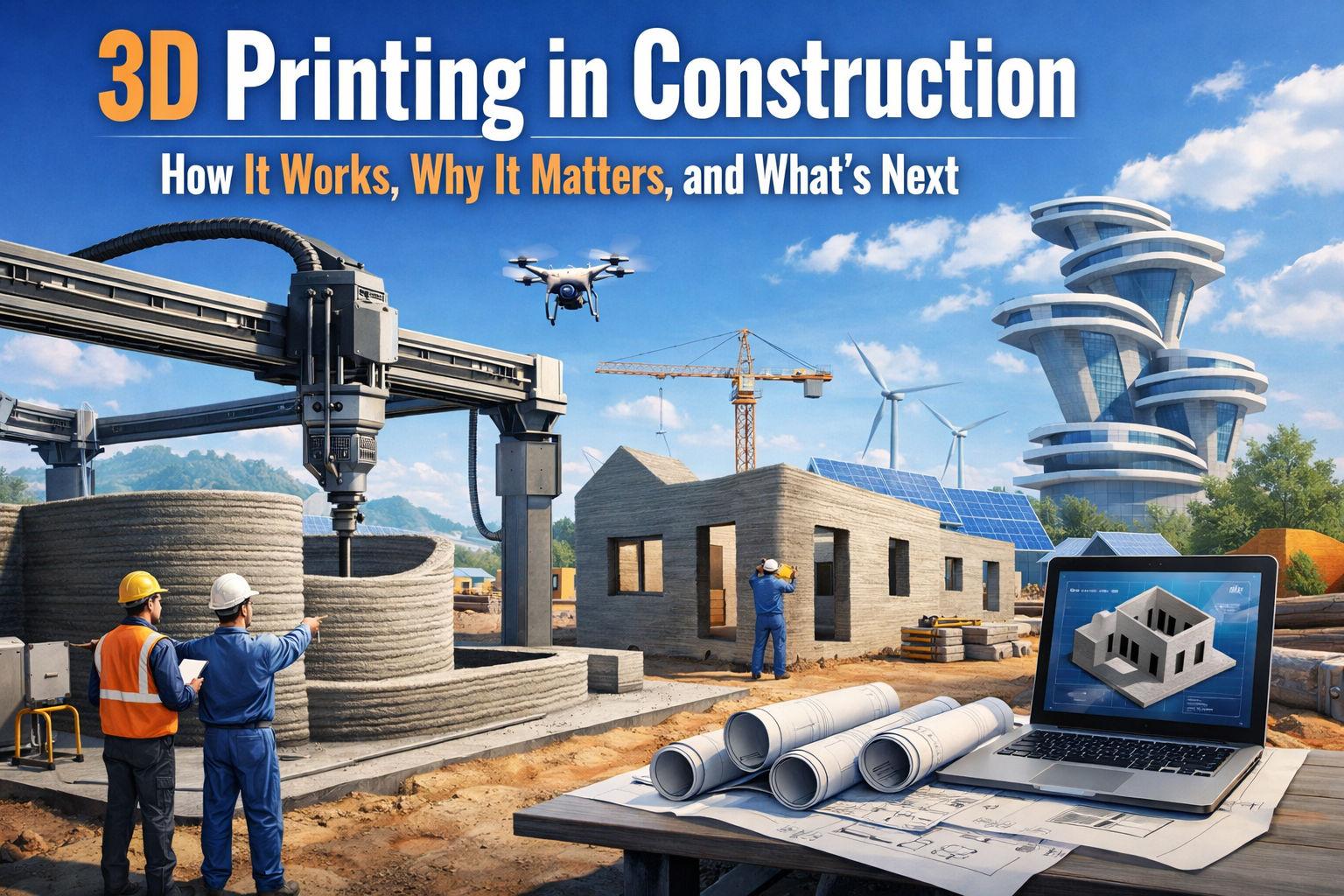
 What Is 3D Printing in Construction?
3D printing in construction, also called additive manufacturing, is the process of building a structure layer by layer based on a digital design. Instead of cutting, casting, or assembling materials the traditional way, a printer deposits material in precise, predetermined paths until the structure is complete.
In construction, this means using large-scale printers equipped with specialised nozzles to deposit concrete, mortar, or other composite materials. The design lives in a Computer-Aided Design (CAD) or Building Information Modelling (BIM) file, which gets sliced into thin horizontal layers. The printer reads those layers as instructions and builds from the ground up.
Think of it like a very large, very precise piping bag laying down concrete in exactly the shapes and quantities a structure needs.
How Does 3D Printing Work on a Construction Site?
The process starts well before the printer arrives on site. Designers use CAD or BIM software to model the structure in 3D. Specialised slicing software then breaks that model into hundreds of thin layers and generates the movement paths for the printer's nozzle.
On site, there are three main types of systems in use today. Gantry systems use a rigid overhead frame that moves along a track, ideal for large, flat footprints. Robotic arm printers offer more flexibility, can navigate complex geometries, and are useful for intricate custom work. Concrete extrusion printers are the most common, depositing concrete mixtures in precise patterns to build walls, floors, and structural elements.
Once printing starts, many systems can run continuously through nights and weekends, something a human crew simply cannot do. When printing is complete, standard finishing work like plumbing, electrical, and interior fitting-out takes over.
Key Benefits of 3D Printing in Construction
There are several reasons construction teams are paying close attention to this technology. Here are the ones that matter most on the ground.
Faster Build Times
3D printing can drastically compress timelines. Structures that would normally take weeks can be printed in days. The continuous operation capability means fewer delays from weather, shift changes, or crew availability.
Cost Savings and Less Waste
Traditional construction often generates significant material waste. 3D printing uses only what is needed, layer by layer. Combined with reduced labour hours, the long-term cost picture is genuinely compelling for the right project types.
Greater Design Freedom
Curved walls, complex geometries, and custom architectural details that would be expensive or nearly impossible using traditional formwork become far more achievable. Architects can design shapes without worrying about whether a construction crew can physically build them.
Improved Safety on Site
Automating parts of the build process means fewer workers exposed to hazardous conditions. There is also less reliance on manual labour in challenging environments, which matters particularly for projects in remote or difficult-to-access locations.
• Reduced manual labour and associated injury risk
• Potential for remote operation via AI-assisted systems
• Lower material costs through precision deposition
• Eco-friendly options including recycled concrete and bio-based materials
• Consistent quality with reduced human error
3D printing will only use the exact quantities needed for each element, resulting in little to no material waste.
Real-World Projects Using 3D Printing
The best way to understand this technology's potential is to look at what it has already built. These are not concepts or renders. They are completed structures.
| Project | Location | Highlight |
|---|---|---|
| Office of the Future | Dubai, UAE | Printed in 17 days, 50% labour reduction, 60% less waste |
| ICON Residential Homes | Texas, USA | Full homes built in under a week, 30% material cost reduction |
| L&T Construction Residential | Chennai, India | 2-storey building, faster turnaround, improved cost efficiency |
| Apis Cor Printed Homes | Russia / USA | 30% material savings, improved energy efficiency |
These projects span commercial offices, military housing, residential buildings, and more. The use cases are broad, and the results are real.
Challenges the Industry Still Needs to Solve
Being honest about the challenges is just as important as recognising the opportunities. 3D printing in construction is not a plug-and-play solution yet.
• Regulatory gaps: No comprehensive building codes for 3D-printed structures in most countries, creating legal uncertainty.
• High upfront costs: Equipment is expensive to purchase or rent, and ongoing material and maintenance costs add up.
• Skills shortage: Operating and maintaining these systems requires specialised training not yet widely available.
• Site conditions: 3D printers prefer controlled, stable environments. Irregular terrain or extreme weather causes problems.
• MEP integration: Embedding mechanical, electrical, and plumbing services requires careful coordination.
• Quality control: Long-term durability data is still limited; standards for testing and certification are still developing.
What Does 3D Printing Cost? Is the ROI Worth It?
This is the question most construction professionals actually care about. The honest answer is: it depends heavily on the project type, scale, and location.
| Factor | Traditional Construction | 3D Printing |
|---|---|---|
| Labour cost | High (ongoing through project) | Lower (automated, reduced crew size) |
| Material waste | Typically 15-30% | Near zero (precision deposition) |
| Build speed | Weeks to months | Days to weeks for comparable structures |
| Design changes | Expensive mid-project | Easier via digital file updates |
| Equipment cost | Standard tools | High initial investment |
For high-volume, repetitive builds such as affordable housing or modular units, the ROI case is strong. For one-off bespoke projects, the numbers are tighter. The technology rewards scale.
Renting a printer is a lower-risk way to test the economics on your next project before committing to ownership.
How to Start Adopting 3D Printing in Your Projects
If you are a construction professional curious about where to begin, here is a practical starting point. You do not need to overhaul your entire operation overnight.
1. Identify a suitable pilot project
Look for a project with repetitive elements, a tight timeline, or a high design complexity requirement. These conditions tend to show the clearest benefit from 3D printing.
2. Partner with an experienced operator
Rather than buying equipment immediately, work with a firm that already operates 3D printing systems. This gets you real project experience without the capital risk.
3. Audit your design workflow
3D printing works best when BIM and CAD workflows are already solid. If your design documentation is inconsistent, fix that first. The printer executes exactly what the file says.
4. Check local regulations early
Talk to your local building authority before committing. Regulatory uncertainty is real, but many jurisdictions are actively developing guidelines. Knowing where you stand early saves headaches later.
5. Train your team
Even if the printer does the physical work, your project managers, site supervisors, and engineers need to understand how the technology integrates with the broader build process.
The Future of 3D Printing in Construction
The trajectory is clearly upward. Grand View Research projects the global 3D construction printing market could grow at a compound annual rate of around 90% between 2024 and 2030. That kind of growth signals an industry that is moving fast.
A few trends worth watching. AI integration is making printers smarter, with machine learning systems that detect print inconsistencies in real time and flag maintenance issues before failures occur. Hybrid systems combining drones, robotic arms, and printing heads are starting to allow simultaneous structural and finishing work.
Material science is also advancing. Geopolymers, bio-based concrete alternatives, and recycled composite materials are giving project teams more sustainable options without sacrificing structural performance.
And perhaps most importantly for the construction industry in markets like India, the portable printer concept is maturing fast. On-site, on-demand printing for remote builds or disaster-relief housing is moving from prototype to practical reality.
3D printing in construction is not replacing traditional building anytime soon. But the professionals who understand it, and know when and how to apply it, will have a genuine competitive edge in the years ahead.
Frequently Asked Questions (FAQs)
Is 3D printing in construction actually cost-effective?
It depends on the project. For repetitive builds like affordable housing or modular units, 3D printing offers strong cost benefits through reduced labour and near-zero material waste. For one-off custom projects, the high equipment cost can offset those savings. The ROI tends to improve significantly at scale.
How durable are 3D-printed buildings?
When the right materials and curing processes are used, 3D-printed structures can match the durability of traditionally built ones. The materials used, typically specialised concrete or geopolymer mixes, are engineered for structural performance. Long-term performance data across different climates is still being collected.
What materials are used in 3D printing for construction?
The most common material is concrete or mortar-based mixtures specifically optimised for printability and structural strength. Projects are also experimenting with geopolymers, recycled concrete, bio-based binders, and certain plastics for non-load-bearing elements.
Can 3D printing be used for large multi-storey buildings?
Most successful applications are currently in the low-rise residential and commercial space. Multi-storey construction using 3D printing is being explored and early examples exist, like the two-storey build by L&T in Chennai, but scaling to high-rise remains a significant technical challenge.
What are the biggest barriers to adopting 3D printing in construction?
The three biggest barriers are the high initial equipment cost, the current lack of clear building codes for 3D-printed structures in many regions, and the shortage of skilled professionals who can operate and maintain the systems. All three are actively being addressed as the industry matures.