


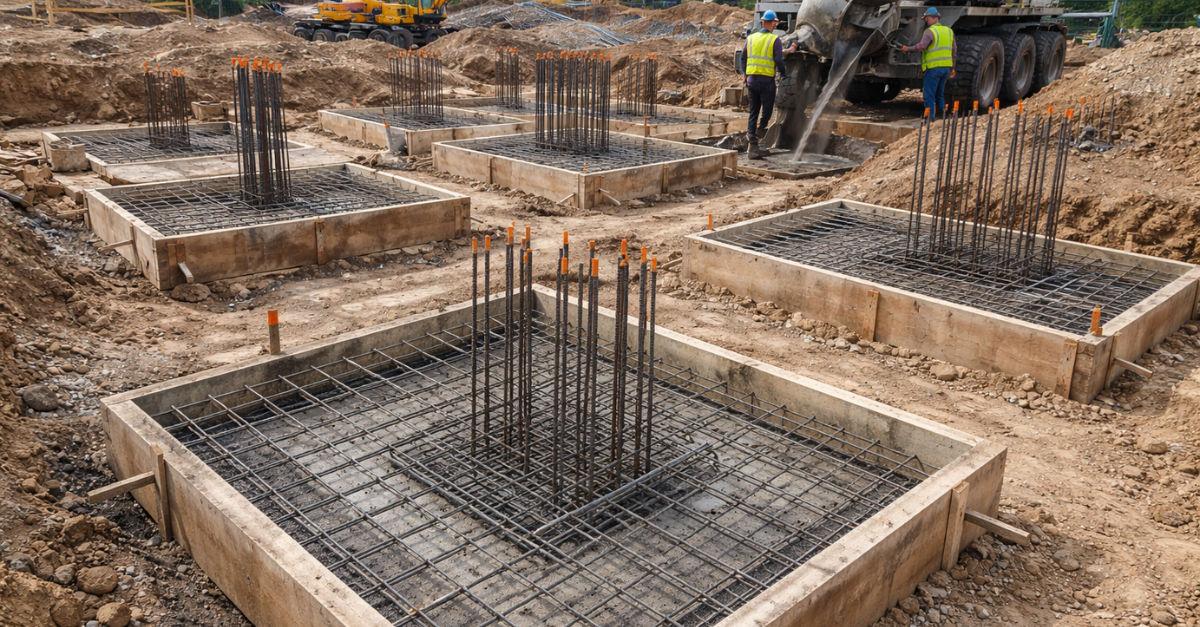
 If you have spent any time on a construction site, you know how much attention goes into what is visible above ground. Walls, columns, beams, finishes. But the part that decides whether all of that stands strong for decades? It is buried underground before the real work even begins.
Footings in construction are that buried part. They are not glamorous. You will not photograph them for a project portfolio. But get them wrong, and everything above them will eventually tell the story.
This guide breaks down exactly what footings are, the types used on real sites, why they fail, and how to get them right the first time.
What Is a Footing in Construction?
A footing is the widened concrete base placed at the bottom of a column or wall. Its job is simple but absolutely critical: spread the load from the structure above across a large enough area of soil so the ground can carry it without shifting or compressing unevenly.
Think of it like this. A column is narrow. The load it carries is concentrated into a small area. Drop that directly on soil without a base, and the pressure becomes too high. The soil gives way. The structure moves.
The footing solves that by distributing the load. More contact area with the soil means lower pressure at any single point. That is the entire logic, and it is why this one element decides so much of what happens later.
Footing vs Foundation: What Is the Difference?
These two words get used interchangeably on site all the time. They are not the same thing.
• Foundation refers to the entire system below ground that supports the structure
• Footing is specifically the bottom most part of that system, the part that directly contacts the soil
So every footing is part of a foundation. But the foundation includes walls, beams, and other elements beyond just the footings. Knowing this distinction helps when reading structural drawings or coordinating with your engineer on site.
Types of Footings in Construction
Not all footings are built the same. The right type depends on your soil conditions, the building load, column spacing, and site constraints. Here are the main types you will encounter on Indian construction sites.
1. Isolated Footing (Individual Footing)
The most common type you will see on residential and small commercial projects. One column gets one footing, usually square or rectangular in shape.
Works well when columns are spaced apart and the soil has reasonable bearing capacity. Most independent houses in India are built on isolated footings.
2. Combined Footing
When two columns sit too close together, or when one column is near a property boundary and cannot be centred, you combine them under one footing.
Combined footings share the load across both columns efficiently. They are rectangular or trapezoidal depending on how the loads are distributed.
3. Strip Footing (Continuous Footing)
Instead of separate pads, a continuous strip of concrete runs along the length of a load-bearing wall. Common in smaller structures, boundary walls, and buildings where wall loads need to be spread along a line rather than at points.
Strip footings are also useful when you have columns aligned in a row and the spacing between them is tight.
4. Strap Footing (Cantilever Footing)
Two isolated footings connected by a strap beam. Used when one column sits near the edge of a site and cannot be centred over its footing. The strap beam transfers the eccentric load to the inner footing, balancing the system.
5. Raft (Mat) Foundation
One large concrete slab covers the entire footprint of the building. Every column and wall sits on this single base.
Raft foundations are used when soil is weak or inconsistent, when individual footings would be too large and start overlapping, or when a structure is very heavy. They are more expensive upfront but they prevent uneven settlement across different parts of the building.
6. Pile Footing (Pile Cap)
When surface soil cannot carry the load, piles are driven or bored deep into the ground to reach stable layers. A pile cap sits on top of the pile group and distributes the column load across them. You typically see this in high-rises, bridges, and sites with poor surface soil conditions.
What Actually Decides the Size of a Footing?
This is where a lot of site-level assumptions go wrong. Footing size is not guesswork, and it is not a fixed standard you carry from one project to the next.
Engineers calculate it using a straightforward logic:
Required footing area = Total column load / Safe bearing capacity of soil
Weak soil means a bigger footing to spread the load further. Strong soil allows a smaller base. After area is determined, the engineer also checks bending, shear stress, and reinforcement requirements before finalising depth and bar sizes.
Soil testing is not optional for this. Skip it, and every number in the design becomes a guess.
Why Footings Fail on Site (And How to Avoid It)
Most footing failures are not design problems. They are execution problems. These are the common ones that show up years later as cracks, settlement, and structural headaches.
• Footing placed on loose or disturbed soil without proper compaction
• Excavation not level or clean before PCC is poured
• Reinforcement bars shifting during concrete pouring due to poor binding or no cover blocks
• Concrete mix quality compromised, leading to honeycombing
• No curing done after pouring, weakening the final concrete strength
The damage from these shortcuts does not appear immediately. You see it months or years later when a corner settles slightly, when hairline cracks appear near window frames, or when doors start sticking. By then, it is too late to fix without significant cost.
Site Habits That Actually Make a Difference
Good footing construction is not complicated. It is consistent. These are the basics that experienced site engineers never skip:
• Always compact the base soil before laying PCC
• Use a PCC (plain cement concrete) layer as a working surface before placing reinforcement
• Check footing dimensions with the drawing before concrete is poured, not after
• Maintain correct clear cover to reinforcement on all sides
• Cure the footing concrete properly for a minimum of 7 days
These steps sound obvious. And they are. But on busy sites with multiple trades running simultaneously and pressure to move fast, these are the exact steps that get rushed or skipped entirely.
How to Read Footing Details on a Structural Drawing
This is something most site guides skip, but it is genuinely useful for anyone supervising footing construction.
On a standard footing detail drawing, look for:
• The plan dimension (length x width of the footing base)
• The depth from ground level to the bottom of the footing
• The PCC thickness below the footing
• The bar size, spacing, and number of layers in both directions
• The clear cover noted at the bottom and sides
When in doubt about any number on the drawing, confirm with the structural engineer before pouring. Concrete cannot be undone.
Common Footing Mistakes That Show Up Too Late
Beyond execution quality, there are decision-level mistakes that also cause long-term problems:
• Reusing footing designs from a previous project on a site with different soil. Soil bearing capacity varies significantly even within a small area.
• Not accounting for future load additions. If floors may be added later, the footing design should factor in the additional weight upfront.
• Building near existing structures without checking for interference with their foundations. New excavation can destabilize nearby footings.
These are not rare cases. They happen regularly on smaller projects where engineering oversight is minimal. Each one is preventable with proper planning.
Final Thoughts on Footings in Construction
Footings in construction are invisible once the project is done. That is precisely why they deserve the most attention before they disappear underground.
The right footing type, correct sizing based on actual soil data, and disciplined execution during pouring are not nice-to-haves. They are the baseline. Everything above, every column, every wall, every floor, is only as good as what sits at the bottom.
Once footings are buried, there is no going back without significant demolition. Get them right the first time.
FAQ: Footings in Construction
What is the purpose of a footing in construction?
A footing spreads the load from a column or wall over a larger area of soil, reducing pressure so the ground can support the structure without settling unevenly or failing.
What is the difference between a footing and a foundation?
The foundation is the entire below-ground support system. The footing is the bottom most element of that system, the part that directly touches and transfers load to the soil.
Which type of footing is best for a house?
For most residential construction with decent soil, isolated footings work well. If soil is weak or inconsistent across the plot, a raft foundation is the safer choice. Always base this decision on a soil investigation, not assumptions.
How deep should footings be?
There is no fixed number. Depth depends on soil type, load, and local conditions. The footing must reach stable soil. In most Indian conditions, this is typically 1 to 1.5 metres below ground level, but your structural engineer will specify the right depth after the soil report.
Can I skip soil testing for a small residential project?
Technically you can. People do it all the time. But many long-term structural problems in smaller buildings trace back to this exact shortcut. Even a basic soil bearing capacity test is far cheaper than dealing with settlement cracks and repairs five years later.