


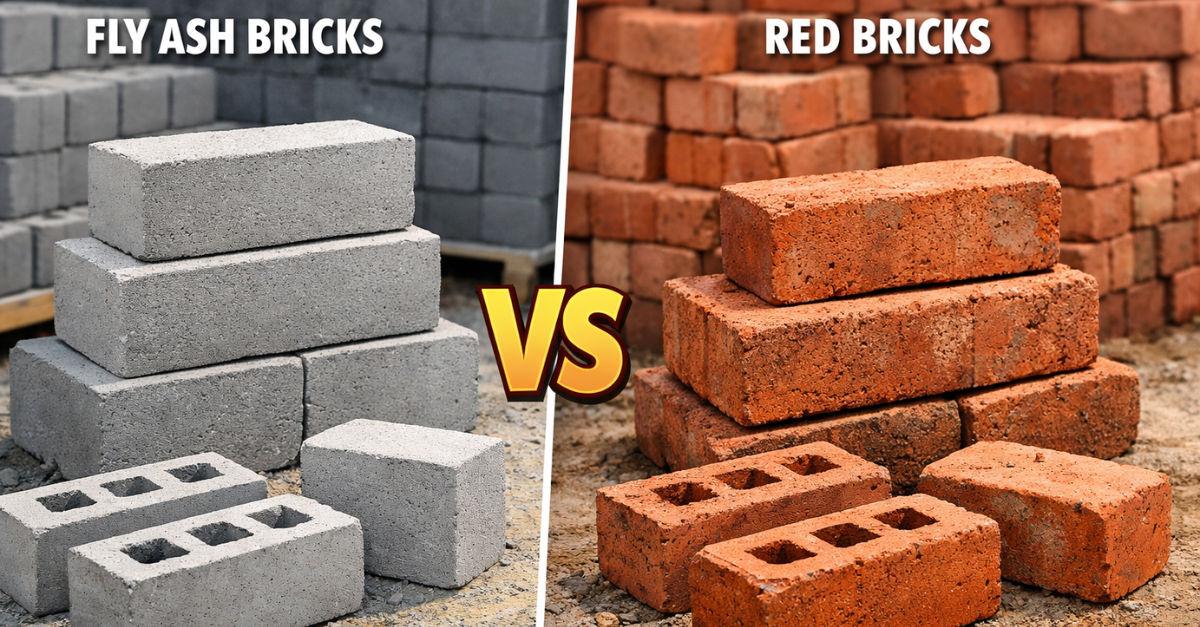
If you work in construction, you have probably heard this debate a hundred times. Fly ash brick vs red brick. Which one should you use? Which one is actually better for your project?
The truth is, both have their place. But over the last decade, fly ash bricks have been steadily taking over, and for good reason. Whether you are a contractor, a builder, or managing a concrete batching plant operation, understanding this shift can save you real money and headaches on site.
Let us break it down properly.
What Are Red Bricks?
Red bricks, also called clay bricks, are one of the oldest building materials in the world. They are made by moulding natural clay and firing it at high temperatures in kilns. The result is a dense, heavy brick with a reddish-brown colour that varies depending on the clay used.
They have been used in Indian construction for centuries and remain widely familiar to masons and contractors across the country.
Key Characteristics of Red Bricks
• Made from natural clay soil
• Strong and durable for traditional structures
• Heavier than fly ash bricks (around 3.5 kg per brick)
• Porous texture that absorbs more water
• Requires manual labour for shaping and drying
• Widely available, especially in rural and remote areas
What Are Fly Ash Bricks?
Fly ash bricks are manufactured using fly ash, a by-product of coal-fired thermal power plants. This industrial waste material is mixed with cement, lime, gypsum, and sometimes sand. The paste is then poured into machine moulds and cured using steam or water.
Since they are produced using a fly ash brick making machine, the output is consistent, uniform, and far less dependent on manual skill compared to red bricks.
Key Characteristics of Fly Ash Bricks
• Uniform size and shape from machine moulding
• Smooth finish that reduces plastering requirements
• Lighter weight (around 2.6 kg per brick)
• High compressive strength of 75 to 100 kg/cm2
• Good thermal and sound insulation
• Eco-friendly because they repurpose industrial waste
Fly Ash Bricks vs Red Bricks: Quick Comparison Table
Here is a side-by-side look at how these two bricks stack up across the factors that matter most on a real construction site.
| Factor | Red Bricks (Clay) | Fly Ash Bricks |
|---|---|---|
| Raw Material | Natural clay soil | Fly ash, cement, lime, gypsum |
| Compressive Strength | 30-35 kg/cm2 | 75-100 kg/cm2 |
| Weight (per brick) | 3.5 kg | 2.6 kg |
| Water Absorption | 20-25% | 6-14% |
| Onsite Wastage | More than 10% | Less than 2-5% |
| Shape & Uniformity | Hand-moulded, uneven | Machine-moulded, uniform |
| Environmental Impact | High (clay mining, kiln burning) | Low (uses industrial waste) |
| Cost per Brick | Rs. 6-8 | Rs. 4-7 |
| Plastering Needed | More (rough surface) | Less (smooth finish) |
| Fire Resistance | Good | Excellent |
| Availability | Everywhere, esp. rural | Mainly urban/semi-urban areas |
Advantages of Fly Ash Bricks
There is a reason fly ash bricks are gaining ground so fast. Here are the biggest benefits:
1. Much Higher Strength
With a compressive strength of 75 to 100 kg/cm2 compared to just 30 to 35 kg/cm2 for red bricks, fly ash bricks can handle significantly more structural load. This makes them a better fit for modern buildings, especially multi-storey structures.
2. Eco-Friendly Manufacturing
Fly ash bricks are made from industrial waste that would otherwise end up in landfills. They do not require topsoil mining or kiln burning, both of which cause serious environmental damage. If sustainability is a priority on your project, this matters.
3. Lower Wastage on Site
Red bricks can have wastage of over 10% during transport and handling. Fly ash bricks, because of their uniform shape and harder surface, have onsite wastage of less than 2 to 5%. Over a large project, that difference adds up fast.
4. Less Mortar and Plastering
The uniform dimensions of fly ash bricks mean walls come out smoother. That reduces how much mortar and plaster you need, cutting down material costs and labour time. For any project running concrete mixers and batching plants at scale, fewer finishing materials means faster turnaround.
5. Better Insulation
Fly ash bricks provide good thermal insulation, which helps regulate indoor temperatures. In hotter climates, that means lower cooling costs for the building occupants over time.
6. Fire Resistant
Thanks to their non-porous structure and high heat resistance, fly ash bricks are more fire resistant than clay bricks. That is a useful safety advantage for commercial and industrial construction.
Disadvantages of Fly Ash Bricks
No material is perfect. Here are the honest drawbacks:
• Lower bonding strength due to their smooth finish. A 1:4 cement-sand mortar ratio is recommended to compensate.
• Requires water curing for at least 7 to 10 days before use on site.
• Not always easy to find in rural or remote locations.
• Some builders still prefer red bricks out of familiarity, which can create pushback during project planning.
Advantages of Red Bricks
Red bricks are not going anywhere just yet. Here is where they still hold their ground:
• High durability and proven strength for load-bearing walls.
• Good fire resistance suitable for traditional structures.
• Widely available across India, including in remote and rural areas.
• Familiar to masons and local contractors everywhere.
• Natural appearance that some projects and clients still prefer.
Disadvantages of Red Bricks
These are the reasons so many construction teams are moving on:
• Causes significant environmental damage through clay mining and kiln-based pollution.
• Heavier weight increases structural load and transport costs.
• High water absorption (20 to 25%) makes walls more prone to dampness and seepage.
• Irregular shapes mean more mortar usage and higher plastering costs.
• Wastage during transport can exceed 10%, which adds up on large projects.
How the Fly Ash Brick Making Machine Has Changed the Game
One of the biggest reasons fly ash bricks have scaled so fast is the technology behind them. A modern fly ash brick making machine can produce thousands of uniform bricks per hour with minimal manual labour. This is a completely different production model compared to hand-moulded red bricks baked in kilns.
Automated brick making plants use robotic procedures and high-pressure moulding to ensure consistency across every single brick. Mobile brick machines have also emerged that use less energy, less water, and produce significantly less waste than traditional setups.
For contractors and developers already working with concrete batching plants and concrete mixers on large projects, fly ash brick production integrates naturally into a more mechanised, efficient workflow. The consistency you get from machine-made bricks also directly reduces rework and quality issues later.
Regulatory Standards You Should Know
If you are sourcing or producing bricks for a professional project, keeping up with the relevant standards is important:
• IS 1077: 1992 (Reviewed in 2021): Covers requirements for clay used in red bricks, including quality and size.
• Environmental Clearance: Required from relevant authorities for fly ash brick manufacturing to assess environmental impact.
• Pollution Control Board Consent: State-level approval to ensure compliance with pollution control regulations.
• Industrial License: Certifies that brick manufacturers are authorised to operate.
• Fire Safety Approval: Compliance with fire safety regulations through periodic inspections.
Always verify that your brick supplier holds the appropriate certifications. This protects your project from regulatory issues and ensures material quality.
Which Brick Should You Choose?
Here is a practical breakdown based on your situation:
Choose Fly Ash Bricks If:
• You want stronger, more uniform bricks for better structural stability.
• Your project is in an urban or semi-urban area with good supply.
• Reducing mortar, plaster, and transport costs is a priority.
• Environmental sustainability matters to your client or project brief.
• You are building a multi-storey or load-intensive structure.
Choose Red Bricks If:
• You are building in a rural or remote area where fly ash bricks are not easily available.
• Your project requires traditional aesthetics or exposed brickwork.
• Local masons and the supply chain are more comfortable with clay bricks.
• Your project is small-scale and cost differences are minimal.
The Future of Bricks: What Is Coming Next
The construction industry is moving fast. Mobile brick machines are already producing high-quality bricks with less energy and water than ever before. Research into alternative sustainable binders and additives is ongoing, and the next generation of fly ash bricks may offer even higher strength and better bonding than what is available today.
For teams already running concrete batching plants and working with ready-mix concrete, the shift toward mechanised, consistent, and eco-friendly materials like fly ash bricks is a natural extension of how the industry is evolving.
The days of relying entirely on hand-made clay bricks for every project are ending. Not because red bricks have failed, but because better, more efficient options are now accessible at scale.
Final Thoughts on Fly Ash Bricks vs Red Bricks
Both fly ash bricks and red bricks have genuine strengths, and the right choice depends on your specific project, location, and priorities. But if you are building in an area with good supply, and structural performance, cost efficiency, and sustainability matter to you, fly ash bricks are the clear choice for modern construction.
The fly ash brick making machine has made it possible to produce consistent, high-strength bricks at scale. Combined with the savings on mortar, plaster, and transport, the numbers speak for themselves. That is why fly ash bricks are replacing red bricks across construction projects all over India.
FAQs: Fly Ash Bricks vs Red Bricks
1. Are fly ash bricks stronger than red bricks?
Yes. Fly ash bricks have a compressive strength of 75 to 100 kg/cm2 compared to just 30 to 35 kg/cm2 for red bricks. This makes them significantly stronger and better suited for modern load-bearing structures.
2. What are the disadvantages of fly ash bricks?
The main disadvantage is lower bonding strength due to their smooth finish. This is usually corrected by using a 1:4 cement-sand mortar ratio. They also require 7 to 10 days of water curing before use, and they may not be easily available in remote areas.
3. Which brick is more eco-friendly?
Fly ash bricks are more eco-friendly. They are made from industrial waste material (fly ash from thermal power plants) and do not require topsoil mining or high-temperature kiln burning, both of which cause environmental damage.
4. What is a fly ash brick making machine?
A fly ash brick making machine is an automated or semi-automated machine that moulds fly ash, cement, lime, and other materials under high pressure into uniform bricks. These machines can produce thousands of consistent bricks per hour and are a key reason why fly ash bricks have become practical at large construction scales.
5. Which brick is cheaper: fly ash or red brick?
Fly ash bricks typically cost Rs. 4 to 6 per brick while red bricks cost Rs. 5 to 8 per brick. When you also factor in lower wastage, less mortar usage, and reduced plastering requirements, fly ash bricks generally result in a lower overall construction cost.
6. Are fly ash bricks better than clay bricks for high-rise buildings?
Yes. Their lighter weight reduces the structural and foundation load, and their higher compressive strength makes them well-suited for multi-storey structures. Most modern high-rise projects in India now prefer fly ash bricks over clay bricks for these reasons.