


 Whether you call them TMT bars, rebars, steel rods, or reinforcement bars, these are the backbone of every structure you walk into. Choosing the right type, and processing them correctly on site, makes the difference between a structure that stands for generations and one that doesn't.
If you are planning a construction project, or you supply materials to one, this guide breaks down every major type of TMT steel bar by grade, explains what each is best used for, and walks you through the machines that process these bars on site. No jargon overload. Just what you need to know.
What Are TMT Steel Bars, Rebars and Steel Rods?
TMT stands for Thermo-Mechanically Treated. These steel bars, also commonly called rebars (short for reinforcement bars) or steel rods, go through a precise three-step process during manufacturing: rapid quenching with water jets, self-tempering using the bar's own residual heat, and finally atmospheric cooling.
The result is a bar with a hard, tough outer layer and a softer, more ductile core. That combination is exactly what makes them so useful in construction. They can absorb stress without cracking, and they bond tightly with concrete to form RCC (Reinforced Cement Concrete) structures.
TMT bars are available in diameters ranging from 8mm all the way up to 32mm, and are graded by the minimum yield strength they can handle before permanent deformation begins.**
Types of TMT Steel Bars, Rebars and Steel Rods by Grade
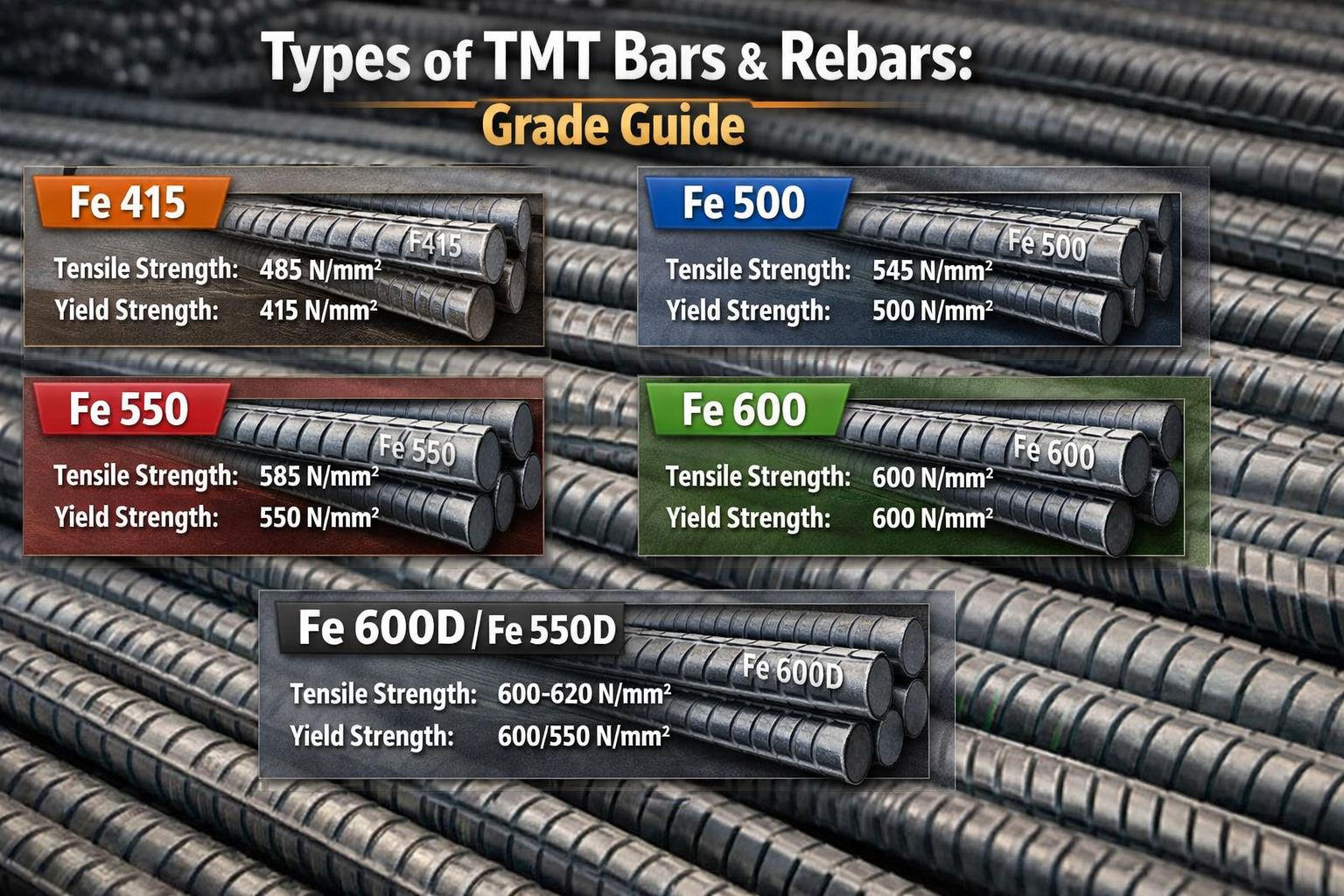
In India, TMT steel bars are classified under four primary grades set by BIS standards. Here is what each one means for your project.
ENTRY LEVEL Fe 415 Steel Bars
With a yield strength of 415 N/mm², Fe 415 is the most flexible and cost-effective grade. It bends easily, making it a go-to for residential homes, small buildings, and low-rise structures. It also handles seismic zones well due to its higher elongation percentage of 14.5%.
MOST POPULAR Fe 500 Rebars and Steel Rods
This is the most widely used grade across India. Fe 500 rebars are roughly 20% stronger than Fe 415, meaning you need fewer bars to achieve the same strength. Ideal for high-rise buildings, commercial complexes, and bridges. The variant Fe 500D offers higher ductility, making it better suited for earthquake-prone areas.
INDUSTRIAL GRADE Fe 550 TMT Bars
Fe 550 is the choice for heavy industrial projects, underground structures, and coastal constructions. Its higher tensile strength handles massive loads without compromise. The Fe 550D variant adds improved ductility for projects where flexibility under stress matters as much as strength.
MAXIMUM STRENGTH Fe 600 Rebars
At a yield strength of 600 N/mm², Fe 600 is the strongest grade available. Reserved for mega-infrastructure projects like highways, flyovers, power plants, marine structures, and metro rail. Fewer bars are needed, which reduces overall material cost at scale.
Quick Reference: Grade Comparison
| Grade | Yield Strength | Elongation % | Best Used For |
|---|---|---|---|
| Fe 415 | 415 N/mm² | 14.5% | Homes, small buildings, seismic zones |
| Fe 500 | 500 N/mm² | 12% | High-rise, commercial, bridges |
| Fe 550 | 550 N/mm² | 10% | Industrial, dams, underground |
| Fe 600 | 600 N/mm² | 8% | Highways, flyovers, power plants, metro |
Special Types of Steel Bars Worth Knowing
CRS (Corrosion Resistant Steel) Bars: These rebars are treated specifically to resist rust and corrosion. If your project is near the coast, in a high-humidity environment, or near industrial chemical exposure, CRS bars extend the life of the structure by decades compared to standard grades.
Earthquake-Resistant (Seismic) Bars: Grades like Fe 500D and Fe 550D carry the "D" suffix for a reason: enhanced ductility. They can flex and absorb energy during seismic activity without snapping. For any project in seismic zones III, IV, or V across India, these are the recommended choice.**
How Steel Bars and Rebars Are Processed On Site
Buying the right grade of TMT bar is only half the job. Once those steel rods and rebars arrive at your site, they need to be cut, bent, decoiled, and threaded to precise specifications before they go into the structure. That is where the right machinery saves time, reduces waste, and keeps workers safe.
Bar Bending Machine
A bar bending machine shapes steel rods and TMT rebars into precise angles and curves, from stirrups for columns to hooks for footings. Manual bending is slow, inconsistent, and exhausting for workers. A good bar bending machine delivers uniform bends at controlled angles every single time, cutting labor time significantly on large sites.
Bar Cutting Machine
A bar cutting machine cuts TMT bars and rebars cleanly to the required length without the distortion that manual cutting causes. Whether you are working with 8mm rods or heavy 32mm rebars, a hydraulic or electric bar cutting machine handles the job cleanly and quickly. Precise cuts also mean less material wastage, which directly reduces project costs.
Rebar Decoiling Machine
TMT bars in coil form, especially thinner diameters like 8mm and 10mm, need to be straightened before use. A rebar decoiling machine unwinds and straightens the coiled rebar automatically, eliminating the dangerous manual practice of unspooling heavy coils by hand. It also speeds up feeding for downstream cutting and bending processes significantly.
Rebar Threading Machine
When rebars need to be mechanically coupled end-to-end rather than lapped or welded, a rebar threading machine cuts precision threads onto the bar ends. This is increasingly required in modern construction for coupler-based joints, which save 25-40% of steel compared to traditional overlap joints. Threading is also mandatory in post-tensioned concrete applications.
Why Site Processing Machines Matter
• Reduce dependence on manual labor for repetitive cutting and bending tasks
• Improve dimensional accuracy, reducing rework and material wastage
• Bar bending and cutting machines work across all TMT grades from Fe 415 to Fe 600
• Rebar threading enables coupler joints, which are stronger and faster than lapped joints
Choosing the Right Steel Rod or Rebar for Your Project
With four main grades and several special types, picking the right TMT bar comes down to four factors.
1. Type of structure: A single-storey home has very different load requirements from a 20-storey residential tower. Fe 415 works well for the former; Fe 500 or Fe 500D is a better choice for the latter.
2. Location and environment: Coastal sites, areas with high humidity, or regions near chemical plants call for CRS bars or at minimum Fe 500D grade to resist corrosion over the long term.
3. Seismic zone: If your site falls in seismic zones III, IV, or V, always specify bars with the "D" designation (higher ductility). Fe 500D is the most common choice for earthquake-resistant RCC construction in India.**
4. Budget vs. quantity: Higher-grade bars cost more per tonne, but you need fewer of them. Fe 500 often works out cheaper overall than Fe 415 when you factor in reduced quantities, lighter structures, and lower logistics costs.
Common Mistakes Contractors Make When Handling TMT Steel Bars
Even the best-quality TMT rebar can underperform if it is not handled correctly on site. These are the mistakes seen most often:
1. Using the wrong grade for the application. Fe 415 may save money upfront on a high-rise project, but the structural consequences of underspecifying steel are serious. Always match the grade to the project type and load requirements.
2. Manual bending without a bar bending machine. Improvised bending damages the bar's surface ribs, reduces ductility at the bend point, and produces inconsistent angles that affect structural integrity.
3. Storing bars directly on the ground. TMT bars stored on bare earth or in contact with standing water corrode faster, even rust-resistant grades. Always store them elevated, covered, and away from moisture.
4. Skipping rebar decoiling before cutting. Coiled rebars that are cut without being properly straightened result in inaccurate lengths and create safety hazards on site as the coil springs back unpredictably.
5. Using lap joints when threaded couplers are required. In high-strength applications, lapping wastes steel and creates congestion in the concrete. A rebar threading machine and mechanical couplers solve both problems.
Wrapping Up
TMT steel bars, rebars, and steel rods come in a well-defined range of grades and types, each designed for a specific job. Fe 415 handles small residential builds, Fe 500 is the workhorse of the industry, Fe 550 takes on industrial and underground projects, and Fe 600 is reserved for the heaviest infrastructure. Specialty grades like CRS and seismic bars fill the gaps where standard grades fall short.
Just as important as choosing the right grade is processing those TMT steel bars correctly on site. A bar bending machine, bar cutting machine, rebar decoiling machine, and rebar threading machine are not optional extras for a serious contractor. They are the tools that turn quality raw material into a quality finished structure.
Get both the grade selection and the site processing right, and your structure will do exactly what it was designed to do: last for generations.**
Frequently Asked Questions
Q: Which TMT bar grade is best for home construction?
Fe 500 or Fe 500D is the most recommended grade for residential construction in India. It offers a strong balance of tensile strength and ductility, handles seismic activity well, and is cost-effective when you factor in the reduced quantity needed compared to Fe 415 bars.
Q: What is the difference between a rebar and a TMT bar?
Rebar is short for reinforcement bar, a general term for any steel bar used to reinforce concrete. A TMT bar is a specific type of rebar that has been Thermo-Mechanically Treated to give it a hard outer layer and ductile inner core. In India, almost all rebars used today are TMT bars.
Q: Why do I need a bar bending machine instead of manual bending?
A bar bending machine produces precise, consistent angles every time, without damaging the ribs or ductility of the TMT bar at the bend point. Manual bending is slow, physically demanding, and introduces inconsistency that can affect structural integrity, especially for higher-grade rebars like Fe 500 and above.
Q: When should I use a rebar threading machine instead of lap joints?
Use a rebar threading machine and mechanical couplers whenever lap jointing would cause steel congestion in columns or beams, or where the structure design specifies coupler joints. Threaded coupler connections also save 25 to 40% in steel usage compared to traditional lap joints, reducing both cost and dead weight in the structure.
Q: What does the 'D' suffix mean in Fe 500D or Fe 550D?
The 'D' stands for ductility. Fe 500D and Fe 550D have higher elongation values and better ductility than their standard counterparts. This makes them more flexible under stress, which is critical in earthquake-prone regions. BIS recommends D-grade bars for all construction in seismic zones III, IV, and V in India.