


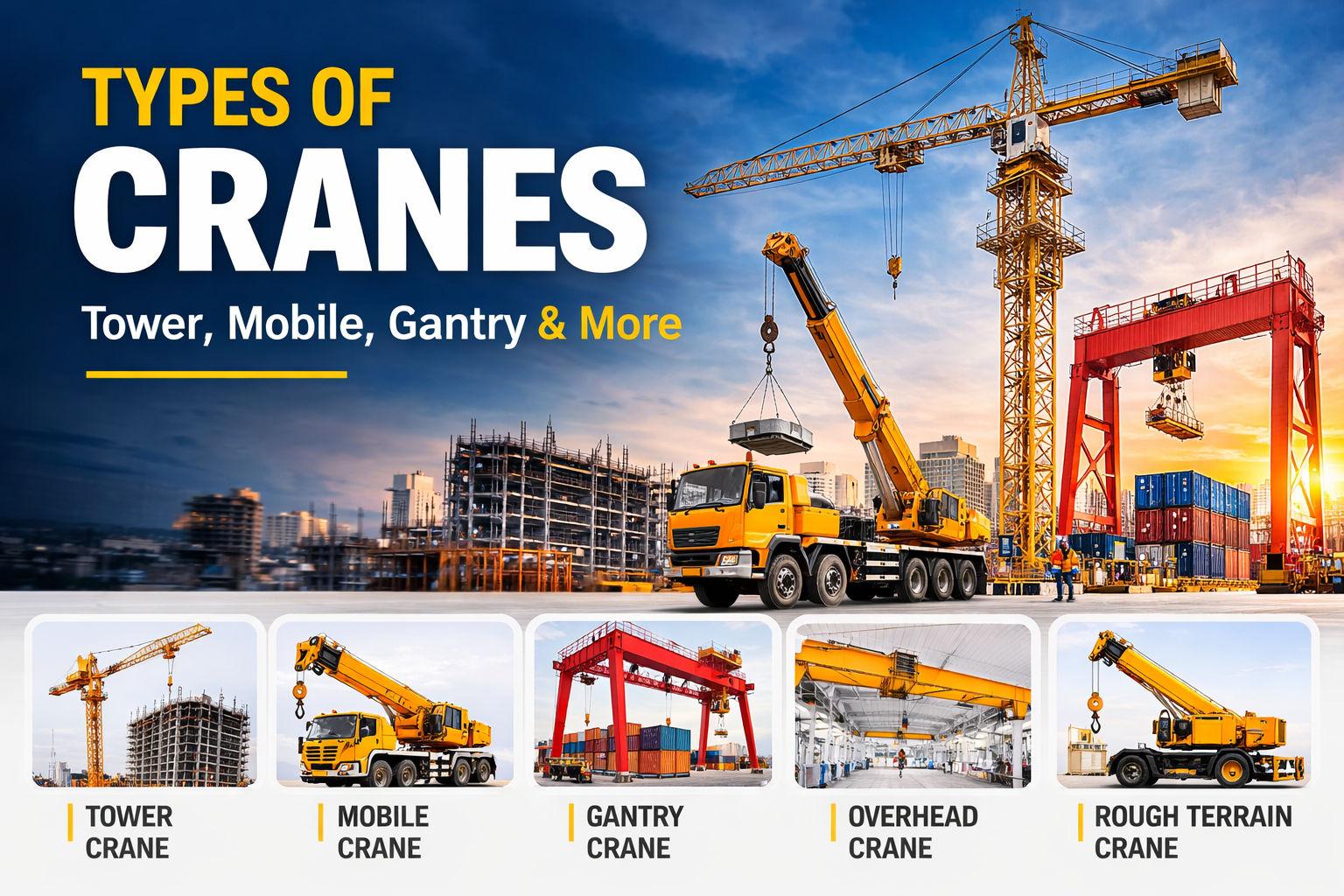
Walk past any major construction project and the first thing you notice is a crane. These steel giants are the backbone of modern construction, making the impossible look effortless. But did you know there are more than a dozen different types of cranes, each built for a very specific job?
Whether you are managing a high-rise build, a warehouse fit-out, or a bridge project in rough terrain, choosing the right mobile crane, tower crane, or overhead crane can mean the difference between a smooth project and an expensive delay.
This guide breaks down every major crane type, what it does best, and how to pick the right one for your project.
What is a Crane Machine and Why Does It Matter?
A crane is a heavy-duty lifting machine designed to move, raise, and position loads that are too large or heavy for manual handling. Modern cranes combine hydraulic power, advanced control systems, and precision engineering to handle everything from a few hundred kilograms to several thousand tonnes.
Cranes are used across construction, logistics, manufacturing, ports, and energy sectors. As cities grow taller and infrastructure projects get more ambitious, the crane industry keeps evolving to meet those demands.
Two Main Categories: Static Cranes and Mobile Cranes
Before diving into specific types, it helps to understand the two broad families that almost every crane belongs to.
Static Cranes: These are fixed in place for the duration of a project. They are great for long-term construction in one location and can handle very heavy loads at great heights. Think of a tower crane anchored to a concrete base.
Mobile Cranes: A mobile crane is designed to move around a job site or travel between sites entirely. They are mounted on rubber tyres, tracks, or truck chassis, giving them flexibility that fixed cranes simply cannot match.
Most projects use one or both. Knowing which category you need narrows down your choice considerably.
Types of Cranes: A Complete Breakdown
Here is a detailed look at the most commonly used crane types across construction and industry.
1. Tower Crane
The tower crane is the classic image most people picture when they hear the word "crane." These tall structures are a fixture on high-rise building sites, with a horizontal jib rotating 360 degrees around a central mast.
Tower cranes can reach extraordinary heights and lift loads of up to 20 tonnes or more. They are assembled on site and grow alongside the building. There are three main subtypes: hammerhead, luffing jib, and self-erecting tower cranes.
Best for: Skyscrapers, bridges, and any tall structural project where height and lift capacity are the priority.
2. Mobile Tower Crane
A mobile tower crane gives you the height advantage of a traditional tower crane with the flexibility of a truck-mounted unit. It requires much less setup time and is ideal for urban projects where space is tight and timelines are short.
These are gaining popularity in city construction because they can be repositioned without a full dismantling process.
Best for: Urban high-rise projects, confined sites, and housing developments.
3. Mobile Crane (General)
The term mobile crane covers a range of truck-mounted and wheel-based cranes that can be driven on public roads. They require minimal setup and can get to work quickly, making them a popular choice for projects where time is money.
They are typically fitted with telescopic booms and outriggers for stability during lifts.
Best for: Multi-site operations, emergency maintenance, and jobs requiring frequent relocation.
4. Crane Truck / Truck Mounted Crane
A crane truck (also called a truck mounted crane or boom truck) combines a standard road-going truck with a mounted crane. The result is a highly mobile unit that needs no special transport and can travel between job sites at highway speed.
They are outfitted with counterweights and outriggers for stability and can handle loads of up to 110 tonnes with the right configuration.
Best for: City construction, repair jobs, and companies managing multiple projects simultaneously.
5. Crawler Crane
A crawler crane runs on steel or rubber tracks rather than wheels, much like a tank. This gives it outstanding stability on soft, muddy, or uneven ground where wheeled machines would get stuck or sink.
Crawler cranes offer the highest lift capacity of any mobile crane and are the go-to choice at the start of large infrastructure projects when the ground is freshly disturbed.
Best for: Power plant construction, wind turbine installation, port projects, and any soft or uneven terrain.
6. All-Terrain Crane
As the name suggests, an all-terrain crane can handle almost any surface. It performs well on rough ground and is also road-legal, making it easy to move between sites. These cranes sit on trucks with anywhere from 6 to 18 wheels and can lift substantially heavier loads than rough-terrain cranes.
Best for: Oil refineries, bridge construction, mixed-terrain projects, and road development.
7. Rough Terrain Crane
A rough terrain crane is designed specifically for off-road work. It runs on four large rubber tyres with four-wheel drive, making it highly maneuverable on uneven surfaces. While it is not road-legal in the same way as an all-terrain model, it offers excellent stability on site.
Best for: Mining sites, remote construction zones, and industrial yards.
8. Overhead Crane (EOT Crane)
An overhead crane, also known as an EOT crane (Electric Overhead Travelling crane), is a fixed crane typically found inside factories, foundries, and warehouses. It runs along steel beams installed at ceiling height, carrying loads horizontally from one end of a building to the other.
EOT cranes are workhorses in manufacturing and heavy industry. They are reliable, efficient, and can be customised for specific load weights and spans.
Best for: Steel plants, automotive manufacturing, and any large industrial facility with repetitive heavy lifting.
9. Gantry Crane
A gantry crane is similar to an overhead crane but is supported by two A-frame legs that run on ground-level tracks rather than ceiling beams. You will often see gantry cranes at shipping ports and rail yards, stacking containers with precision.
They can also be used outdoors, which gives them flexibility that traditional overhead cranes lack.
Best for: Ports, shipyards, precast concrete yards, and outdoor heavy-lift operations.
[Internal link: gantry-crane-blog] Learn more about gantry crane types and uses
10. Jib Crane
A jib crane has a horizontal arm (the jib) mounted on either a wall bracket or a floor-standing pillar. A hoist travels along the arm, allowing the crane to swing materials within a fixed arc around the mounting point.
They are permanently installed over a specific workstation and are ideal for repetitive tasks in the same area.
Best for: Machine shops, assembly lines, loading bays, and any workstation with repetitive lifting needs.
11. Hydra Crane (Pick and Carry Crane)
The hydra crane is one of the most popular and practical cranes on Indian construction sites. It can lift a load and carry it across a site without needing to set down and rerig, saving enormous amounts of time on busy project floors.
Compact, affordable, and easy to operate, hydra cranes punch well above their weight on infrastructure and industrial projects.
Best for: Industrial lifting, infrastructure sites, and warehouse material movement.
12. Franna Crane (Pick and Carry)
The Franna crane is a specific type of pick and carry crane that is extremely popular in Australia and increasingly common on international job sites. It has a free-slewing boom and can travel while carrying a suspended load, making it ideal for moving materials across large open sites.
Franna cranes are faster on site than many other mobile options and require no outriggers for most lifts.
Best for: Infrastructure projects, pipeline work, precast panel installation, and open-site material handling.
13. Knuckle Boom Crane
A knuckle boom crane (also called a loader crane or articulated crane) has a hinged arm that folds like a finger, allowing it to work in tight spaces where a straight boom simply could not reach. It is most commonly mounted on a truck and used for delivery and placement of heavy materials.
The articulated design means it can fold away neatly when not in use, making it incredibly practical for urban environments.
Best for: Urban delivery, pipe laying, timber handling, and any confined-space lifting task.
14. Service Crane
A service crane is a lighter-duty crane mounted on a service vehicle or utility truck. These are primarily used for maintenance, repair, and assembly tasks where a full-sized crane would be overkill. They are common in telecommunications, energy, and field service industries.
Best for: Maintenance operations, utilities, and remote field service jobs.
15. Mini Crane
Do not let the size fool you. A mini crane can reach places that larger machines simply cannot access, from inside shopping centres to narrow alleyways and heritage-listed buildings. They are often remote-controlled and can be transported in a standard van or elevator.
Mini cranes are becoming increasingly popular in urban construction and renovation work where space is at an absolute premium.
Best for: Indoor installation, urban renovation, tight-access worksites, and glass or stone placement.
Quick Comparison: Types of Cranes at a Glance
| Crane Type | Mobility | Best Use Case | Lift Capacity | Terrain |
|---|---|---|---|---|
| Tower Crane | Stationary | High-rise construction | Very High | Stable foundation |
| Mobile Tower Crane | High | Urban high-rise, confined sites | High | Road / Urban |
| Mobile Crane | Very High | Multi-site operations | Medium-High | Most surfaces |
| Crane Truck / TMC | Very High | City jobs, repairs | Medium | Paved roads |
| Crawler Crane | Low | Heavy infrastructure | Highest | Soft / uneven ground |
| All-Terrain Crane | Very High | Mixed terrain projects | High | Any terrain |
| Rough Terrain Crane | Medium | Off-road, mining | High | Rough off-road |
| EOT / Overhead Crane | Stationary | Factory / warehouse | High | Indoor rails |
| Gantry Crane | Low-Medium | Ports, yards | Very High | Track-based |
| Jib Crane | Stationary | Workstation lifting | Low-Medium | Indoor floor |
| Hydra Crane | Medium | Pick and carry on site | Medium | Site floor |
| Franna Crane | High | Open-site carry lifts | Medium | Open ground |
| Knuckle Boom Crane | High | Tight spaces, delivery | Medium | Urban / road |
| Service Crane | High | Maintenance and repair | Low-Medium | Road / field |
| Mini Crane | High | Tight indoor access | Low | Indoor / confined |
Key Features of Modern Cranes in 2026
Crane technology has come a long way. The machines built and used today look very different from those of even a decade ago. Here are the features that are now standard or rapidly becoming so.
• Remote control and semi-autonomous operation for high-risk lifts
• IoT-based monitoring with real-time load and structural data
• GPS tracking for fleet management and safety compliance
• Smart load management systems that prevent overloads automatically
• Hybrid and electric drive systems for reduced emissions
• Compact, foldable designs for tight urban sites
• Low-noise operation modes for work near residential areas
Where Are Cranes Used? Industry Applications
| Industry | Common Crane Types | Key Purpose |
|---|---|---|
| Construction | Tower crane, mobile crane, hydra crane | High-rise structures, material handling |
| Ports and Logistics | Gantry crane, crawler crane, knuckle boom crane | Container stacking, cargo loading |
| Manufacturing | EOT crane, jib crane, overhead crane | Machine installation, production line movement |
| Infrastructure | EOT crane, jib crane, overhead crane | Bridges, highways, tunnels, metro |
| Mining and Energy | Rough terrain crane, crawler crane, service crane | Equipment installation, remote site work |
| Warehousing | Mini crane, mobile crane, jib crane | Lightweight indoor and storage lifting |
How to Choose the Right Crane for Your Project
With so many crane types available, choosing the right one comes down to a few key questions. Get these right and the rest falls into place.
1. What is the load weight and size? Every crane has a rated lift capacity. Always work within that limit with a safety margin built in.
2. What is the site terrain like? Soft, muddy, or freshly broken ground calls for a crawler crane. Hard, flat surfaces suit wheel-mounted options.
3. How high does the load need to go? For extreme heights, a tower crane or luffing jib tower crane is the answer. For lower lifts, a mobile crane may be sufficient.
4. How long is the project? Long-term projects justify the setup cost of a tower crane. Short-term or multi-site work suits a truck mounted crane or mobile crane.
5. How tight is the space? Confined sites call for compact options like a mini crane, mobile tower crane, or knuckle boom crane.
6. Is the crane working indoors or outdoors? Indoor, repetitive lifting is the home of the overhead crane, EOT crane, and jib crane. Outdoor versatility points to mobile options.
Trends Shaping the Crane Industry in 2026
The crane industry is going through one of its most exciting periods of innovation. Here is what is driving change right now.
Electrification: Hybrid and fully electric cranes are entering the market, reducing emissions and operating costs, especially on urban sites with strict noise and pollution rules.
Remote and autonomous operation: Cranes operating in hazardous environments are increasingly controlled remotely, keeping operators safe while maintaining productivity.
Predictive maintenance via IoT: Sensors embedded throughout crane structures feed real-time data to maintenance teams, catching faults before they become failures.
Compact urban cranes: As cities build denser and in tighter footprints, the demand for mini cranes, mobile tower cranes, and knuckle boom cranes is rising fast.
Sustainability: Low-noise, low-emission cranes are being specified on more projects as environmental standards tighten globally.
Safety Practices for Crane Operations
A crane is only as safe as the people operating and managing it. Here are the non-negotiables on any responsible job site.
• Always verify the crane's rated load capacity before any lift
• Ensure operators are trained, certified, and licensed (required by OSHA and most national standards)
• Carry out daily pre-operational inspections
• Use clearly marked exclusion zones and audible warning systems
• Confirm site ground conditions before positioning any crane
• Never lift in wind speeds above the manufacturer's recommended limit
• Keep maintenance records up to date for all crane components
Choosing the Right Crane Sets Your Project Up for Success
From the mighty tower crane reshaping city skylines to the humble mini crane squeezing into tight renovation sites, every crane type in this guide has a job it does better than any other. The key is matching the crane to the specific demands of your project.
Understanding the differences between a mobile crane, overhead crane, gantry crane, jib crane, hydra crane, and all the others gives you a real advantage when planning lifts, managing budgets, and keeping your site running safely and on schedule.
As the crane industry evolves with smarter technology and more sustainable machinery, staying informed means you will always be ready to pick the right tool for the job.
Frequently Asked Questions
Q1: What is the difference between a mobile crane and a tower crane?
A mobile crane can move around the job site or travel between sites, making it ideal for short-term or multi-location work. A tower crane is fixed in one location, offers greater height and lift capacity, and is used for long-term construction projects like high-rise buildings.
Q2: What is an EOT crane used for?
An EOT crane (Electric Overhead Travelling crane) is used primarily in factories and industrial facilities for moving heavy loads along a predetermined path at ceiling height. Common applications include steel manufacturing, automotive plants, and large warehouses.
Q3: What is the difference between a gantry crane and an overhead crane?
Both lift and move loads horizontally. The main difference is that an overhead crane is supported by beams attached to the building structure, while a gantry crane has its own freestanding legs running on ground-level tracks. Gantry cranes can be used outdoors.
Q4: When would you use a knuckle boom crane instead of a straight boom crane?
A knuckle boom crane is ideal when you need to work in confined spaces or around obstacles, as the articulated arm can fold and reach in ways a straight boom cannot. It is common for urban delivery, pipe laying, and any job where access is restricted.
Q5: Is a hydra crane the same as a franna crane?
They belong to the same "pick and carry" category but are different machines. A hydra crane is widely used in India and is a compact, cost-effective option for site lifting. A Franna crane is a specific Australian-origin brand and design known for its free-slewing boom and ability to carry loads at higher capacities across open ground.
Q6: What is a mini crane best used for?
A mini crane excels in tight-access environments where larger machines simply cannot fit, such as inside buildings, narrow corridors, rooftops, or heritage sites. They are often remote-controlled and can be transported in a standard van or elevator, making them a growing choice in urban renovation projects.