
Have you ever wondered why some roads stay smooth for 15 years while others develop ruts and cracks within two monsoons?
A big part of the answer is decided long before the first truck of asphalt reaches the site. It is decided in a lab, with a small cylindrical sample, a water bath and a loading machine. That test is the Marshall Stability Test. Every bituminous layer in a road, from DBM to BC, starts its life as a Marshall mix design in the lab.
After years of working around pavement materials, I can tell you this: if you understand this one test properly, bituminous mix design stops feeling like a black box. This guide walks you through it in plain language.
What Is the Marshall Stability Test?
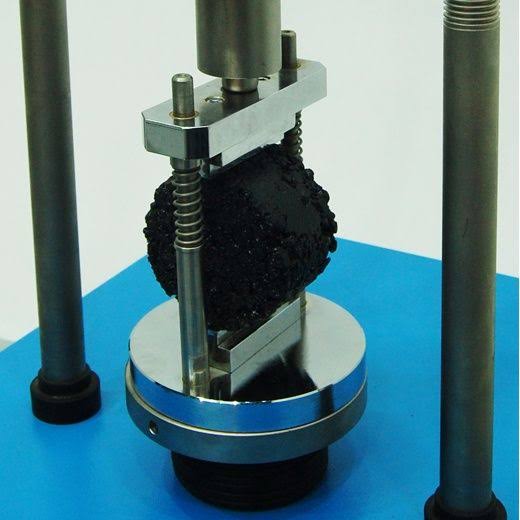
The Marshall Stability Test measures how well a compacted bituminous (asphalt) mix resists deformation under load. It was developed by Bruce Marshall of the Mississippi Highway Department in the 1940s and later refined by the U.S. Army Corps of Engineers. Today it is standardised under ASTM D6927 and AASHTO T245, and it is widely used in India through MoRTH specifications and IRC guidelines.
The test gives you two headline numbers:
- •Marshall Stability: the maximum load (in kN) the sample carries before failing.
- •Flow Value: how much the sample deforms (in mm) at that maximum load.
Together with density and void analysis, these numbers help you find the best amount of bitumen for your aggregate blend.
Why Does This Test Matter?
Bitumen is expensive, and the amount you add is a delicate balance:
- •Too little bitumen: the mix is dry and brittle, ravels easily and cracks early.
- •Too much bitumen: the mix turns soft and slippery, causing rutting, shoving and bleeding in hot weather.
The Marshall test helps you find the sweet spot. It also helps you:
- •Compare different aggregate gradations
- •Check whether a mix suits heavy traffic or light traffic
- •Control quality during construction by testing plant-produced mix
- •Evaluate mix performance in hot climates like North India, where summer pavement temperatures can cross 60°C
- •Different layers also need different mixes. A base layer is built for strength, while a surface layer is built for smoothness and durability. If these terms are new to you, our guide to DBM, BC & SDBC explains what each layer does in a pavement.
Equipment You Need
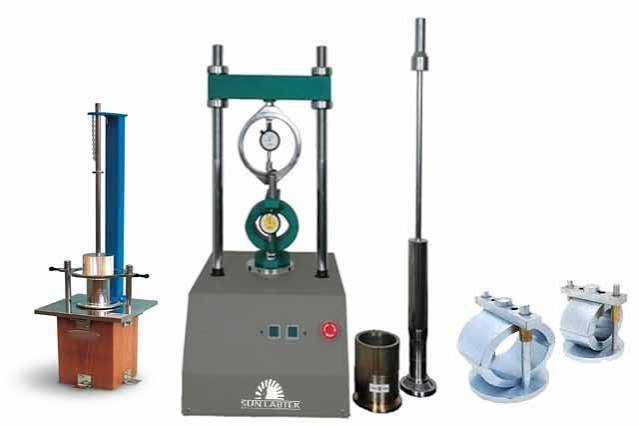
- •Marshall compaction mould (101.6 mm diameter, about 75 mm height) with base plate and collar
- •Marshall automatic or manual compaction hammer (4.54 kg weight, 457 mm free fall)
- •Marshall loading machine with a proof ring or load cell and flow dial gauge
- •Breaking head (a pair of curved steel segments)
- •Thermostatically controlled water bath
- •Oven, mixing bowl, thermometers and weighing balance
Marshall Stability Test Procedure, Step by Step
Step 1: Prepare the aggregates and bitumen
Dry and sieve the aggregates, then blend them to match the specified gradation. Each specimen uses roughly 1,200 g of aggregate. Prepare at least three specimens for each bitumen content, with contents varying in steps of 0.5%.
Step 2: Heat the materials
Heat the aggregates and bitumen separately. Bitumen is usually heated to the temperature giving a viscosity of around 170 ± 20 centistokes for mixing. Aggregates are heated slightly above this to compensate for heat loss during mixing.
Step 3: Mix
Add the bitumen to the hot aggregates and mix thoroughly until every particle is uniformly coated.
Step 4: Compact
Place the mix in the preheated mould and compact it with the Marshall hammer. The number of blows on each face depends on traffic:
- •35 blows: light traffic
- •50 blows: medium traffic
- •75 blows: heavy traffic
Then flip the sample and apply the same number of blows on the other face.
Step 5: Cool and extrude
Let the specimen cool, then extrude it from the mould. Measure its height and record its weight in air and in water. You need these to calculate bulk density.
Step 6: Condition in the water bath
Place the specimens in a water bath at 60°C for 30 to 40 minutes. This simulates a hot pavement in service, which is the harshest condition for asphalt.
Step 7: Test
Take the specimen out, place it in the breaking head, and load it at a constant rate of 50.8 mm per minute. Complete the test within about 30 seconds of removing it from the bath, or the sample will cool and give misleadingly high results.
Record the maximum load (stability) and the deformation at that load (flow). Apply the correction factor if the specimen height differs from the standard.
Beyond Stability and Flow: The Volumetric Analysis
The Marshall test is more than a crushing test. Before breaking the samples, you calculate their volumetric properties:
- •Bulk density (Gmb): how compact the mix is
- •Air voids (Va): the small pockets of air left in the mix
- •Voids in Mineral Aggregate (VMA): the space available for bitumen and air
- •Voids Filled with Bitumen (VFB): the share of VMA filled by bitumen
These numbers are just as important as stability. A mix with high stability but poor air voids will not last on the road.
How Marshall Results Affect Mix Design
This is where the test becomes truly useful. You plot the results against bitumen content and read the trends.
What the graphs typically show:
| Property | Trend as bitumen content increases |
|---|---|
| Stability | Rises to a peak, then falls |
| Bulk density | Rises to a peak (usually slightly after stability), then falls |
| Flow value | Increases steadily |
| Air voids | Decrease steadily |
| VFB | Increases steadily |
| VMA | Falls to a minimum, then rises |
Finding the Optimum Bitumen Content (OBC)
A common method (Asphalt Institute approach) averages three bitumen contents:
- •The content at maximum stability
- •The content at maximum bulk density
- •The content at the target air voids (typically around 4%)
OBC = (B1 + B2 + B3) / 3
Then you check that the mix at OBC meets all requirements for stability, flow, air voids, VMA and VFB. If any property fails, you adjust the gradation or change the materials and try again. Some agencies, like MoRTH, specify the design air void target directly, so always follow your project specification.
Typical Requirements
Values vary by specification, layer type and traffic, so treat these as a rough guide:
- •Minimum stability: around 8 to 9 kN for heavy-traffic mixes (75 blows)
- •Flow: about 2 to 4 mm
- •Air voids: about 3 to 6%
- •VFB: about 65 to 75%
- •Marshall Quotient (stability ÷ flow): an indicator of stiffness; higher values suggest a stiffer mix, but very high values can mean a brittle one
Always confirm the limits in your contract specification (for example, MoRTH Section 500 in India).
What Your Results Are Telling You
- •High stability, very low flow: the mix is stiff and brittle, with a risk of cracking.
- •Low stability, high flow: the mix is too soft and prone to rutting, often from excess bitumen or weak aggregate structure.
- •Low air voids: the mix may bleed or rut in summer heat.
- •High air voids: water and air can enter, causing stripping and oxidation.
- •Low VMA: there isn't enough room for bitumen, so durability suffers.
Limitations of the Marshall Test
To be a trustworthy engineer, you should also know where the test falls short:
- •It doesn't directly simulate real traffic loading and shear stresses.
- •Impact compaction differs from field rollers.
- •It doesn't measure fatigue or moisture damage on its own.
That's why modern practice complements it with Superpave mix design, wheel tracking tests, indirect tensile strength and tensile strength ratio (TSR) tests. Even so, the Marshall method remains popular because it is simple, inexpensive and well understood.
Practical Tips from the Field
- •Control temperature closely. A few degrees off in mixing or compaction can shift results noticeably.
- •Don't skip the water bath timing. Under-conditioned samples read high.
- •Test at least three samples per bitumen content and average them to reduce scatter.
- •Calibrate your proof ring or load cell regularly.
- •Re-verify the mix design when your aggregate source changes, even if the gradation looks the same.
Final Thoughts
The Marshall Stability Test is a simple test with a big responsibility. It tells you whether your asphalt mix can carry traffic, resist heat and last through years of weather. When you read the numbers together (stability, flow, air voids, VMA and VFB), you get a full picture of how a mix will behave on the road.
Master this test, and you'll not only design better mixes but also catch problems before they turn into potholes.
Frequently Asked Questions
What is a good Marshall stability value? For heavy-traffic pavements, the minimum is generally around 8 to 9 kN, though the exact value depends on your specification and mix type.
Why is the Marshall specimen tested at 60°C? Because 60°C approximates the hottest pavement temperature, when asphalt is weakest. Passing at this temperature gives confidence for the whole year.
What is the Marshall Quotient? It is stability divided by flow (kN/mm) and gives an approximate measure of the mix's stiffness and resistance to deformation.
How many samples are needed for the Marshall test? At least three specimens per bitumen content, usually across five bitumen contents, so about 15 specimens per trial.
Is the Marshall method still used? Yes. It remains widely used in India and many other countries, often alongside Superpave for major projects.