


In the next few minutes, you will learn:
• What machine downtime really is
• How one breakdown can push your whole project behind schedule
• A simple formula to work out your true downtime cost
• 7 easy habits that keep your machines working
What Is Machine Downtime?
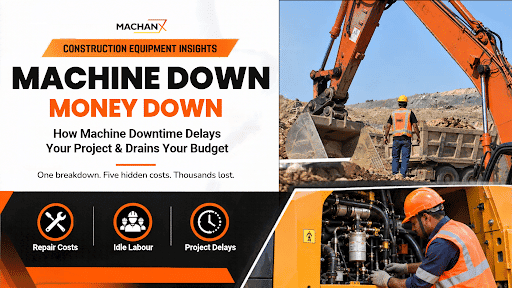
Simply put, downtime is the time your machine sits idle when it should be working. It comes in two types:
• Planned downtime: servicing, oil changes and inspections. You schedule it, so it does little harm.
• Unplanned downtime: sudden breakdowns. These arrive at the worst moment and do the real damage.
The Domino Effect: How One Breakdown Delays Everything
Construction work follows a fixed order. Digging comes before foundations. Foundations come before the structure. So when one machine stops, everything behind it has to wait.
Here is how a single breakdown spreads across your site:
1. The machine stops. The task it was doing stops too.
2. Your crew stands idle. You still pay their wages for every hour.
3. Deliveries clash. Concrete and material trucks arrive with no place to unload, and bookings must be rescheduled.
4. You hunt for a replacement. Finding a rental machine and moving it to site takes time.
5. The deadline slips. If your contract has penalty clauses, delay becomes a direct cost.
The 5 Layers of Downtime Cost
Most people only count the first layer. Smart buyers count all five.
| Cost layer | What it includes |
|---|---|
| 1. Repair cost | Spare parts, mechanic labor, transport of the machine |
| 2. Rental cost | Hiring a replacement machine while yours is down |
| 3. Idle labor | Operators and workers waiting with nothing to do |
| 4. Lost productivity | Work you planned for the day but could not finish |
| 5. Delay cost | Extra site expenses, penalties and unhappy clients |
Industry sources estimate that one unplanned breakdown can cost roughly $2,000 to $10,000 a day once idle crews, rentals and penalties are counted. These figures come mostly from US-based sources, so treat them as a guide. Your own number depends on your project size, machine type and contract. That is why calculating your own matters.
Try It Yourself: The Downtime Cost Formula
The formula
Total Downtime Cost = Repair Cost + Rental Cost + (Idle Crew Cost per Hour × Downtime Hours) + Delay Cost
Example (illustrative numbers): An excavator is down for 3 working days, which is 24 hours.
| Item | Calculation | Cost |
|---|---|---|
| Repair | Parts and mechanic | ₹40,000 |
| Rental replacement | ₹18,000 × 3 days | ₹54,000 |
| Idle crew | ₹1,500 per hour × 24 hours | ₹36,000 |
| Delay cost | ₹25,000 × 3 days | ₹75,000 |
| TOTAL | = | ₹2,05,000 |
The repair was only about 20% of the real cost. The other 80% was hidden. Track your own numbers once and you will never look at a breakdown the same way again.
Why Do Machines Break Down?
• Skipped or delayed servicing
• Overloading, or using the machine for the wrong job
• Untrained or careless operators
• Old machines that need constant repair
• Spare parts that are hard to find
• Pushing machines too hard during busy project phases
That last one is a trap. When the site is busiest, teams push service dates back because they cannot spare the machine. That is exactly when a breakdown hurts the most. Industry reports say nearly 70% of construction firms have faced project delays linked to equipment availability.
7 Easy Ways to Cut Downtime
1. Service by engine hours, not dates. Machines wear with use, not with the calendar.
2. Do a 5-minute daily check. Look at oil, coolant, leaks, tyres or tracks, and warning lights before starting.
3. Know your critical machines. Rank them by how badly the project stops if they fail, and protect those first.
4. Keep key spares ready. Filters, belts, hoses and fuses cost little compared with a day of waiting.
5. Train your operators. Careful operation prevents many failures.
6. Keep a service log for every machine. Write down repairs, costs and downtime days. Patterns show up fast.
7. Have a backup plan. Know which rental supplier you will call before you need one.
Repair, Rent or Replace?
Keep track of repair costs over time. A common rule of thumb says it may be time to replace a machine when repair costs go above 50% of its current market value, or when breakdowns keep rising even with regular servicing. It is a guide, not a law, so compare it with your cost per hour too.
Smart Buyers Think About Downtime Before They Buy
Downtime does not start on site. It starts at the buying stage. Before you buy or rent any machine, ask:
• Is there a service centre or mechanic close to my site?
• How fast can I get spare parts?
• What does the warranty really cover?
• For used machines: can I see the full service history?
Quick FAQs
What is the biggest cost of machine downtime?
Usually not the repair. Idle labor, delays and lost productivity together are often much larger.
How do I calculate downtime cost?
Add repair cost, rental cost, idle labor cost and delay cost, using the formula above.
Is preventive maintenance worth it?
In most cases, yes. Planned servicing is cheaper and easier to schedule than an emergency repair.
How can I reduce downtime on a busy project?
Service critical machines before the busy phase, keep spares ready and line up a backup rental option.
The Bottom Line
Machine downtime is not just a repair problem. It is a schedule problem and a money problem. Work out your real cost, protect your most important machines, and choose equipment that comes with reliable support.