


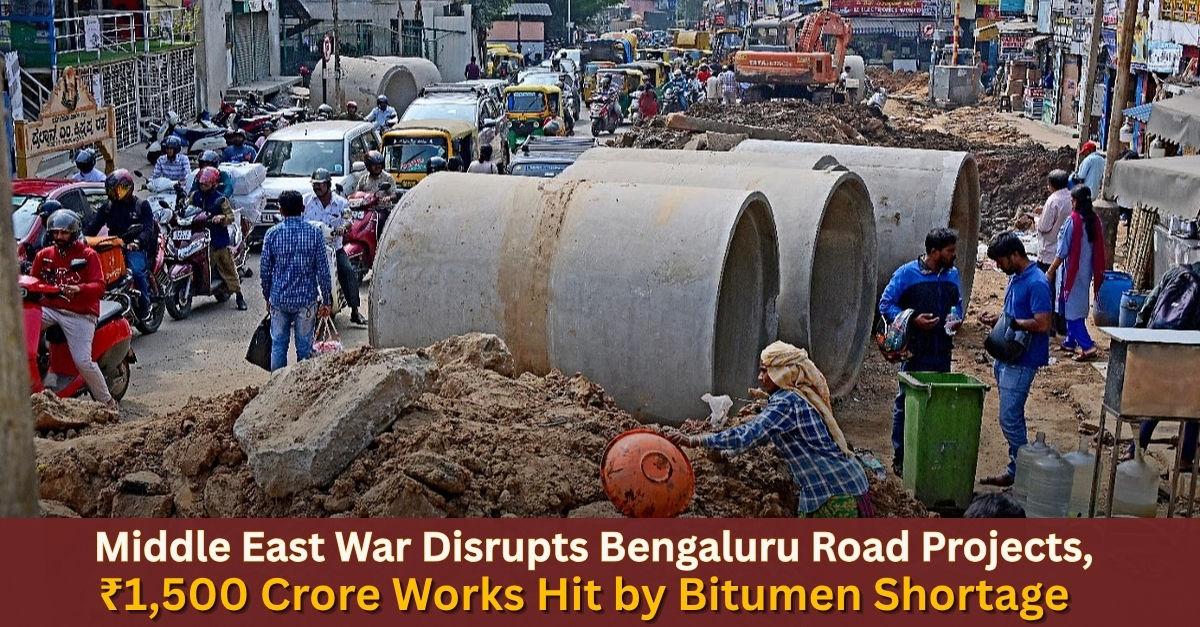
 The ongoing conflict in West Asia is now beginning to have visible ripple effects on infrastructure development in India, with Bengaluru emerging as a key example of how global geopolitical tensions can disrupt local projects. Road construction and asphalting work across the city have slowed significantly due to a sharp rise in bitumen prices and growing uncertainty around its supply. This disruption is particularly concerning given the scale of projects currently underway and the approaching monsoon season.
Contractors associated with the Bruhat Bengaluru Mahanagara Palike (BBMP) Contractors’ Association have indicated that asphalting activities have largely come to a halt in recent days. The primary reason cited is the steep increase in the cost of bitumen, a key material used in road construction. Before the escalation of tensions in West Asia, contractors were procuring bitumen at approximately ₹45,000 per tonne. However, prices have now surged to around ₹65,000 per tonne, marking an increase of nearly 20 percent within a short period.
This sudden spike has created a financial strain for contractors who are operating under fixed-price agreements. Since most tenders were approved based on earlier cost estimates, contractors argue that continuing work at current rates would lead to significant losses. As a result, many have chosen to pause work rather than absorb the additional costs. Several contractors have suggested that if the civic body wants projects to proceed without delay, it should consider procuring and supplying bitumen directly.
The impact of this disruption is substantial, with road projects worth nearly ₹1,500 crore currently in various stages of execution across Bengaluru. These projects were expected to improve road conditions and address long-standing infrastructure gaps in multiple parts of the city. However, the ongoing slowdown now threatens to delay their completion timelines, raising concerns about deteriorating road quality in the near future.
The timing of this disruption is particularly critical. Bengaluru typically accelerates roadwork activities ahead of the monsoon to ensure that roads are in good condition before heavy rains begin. Delays in asphalting during this period could result in widespread issues such as potholes, waterlogging, and increased traffic congestion. Poor road conditions during the monsoon not only affect daily commuters but also pose safety risks and increase maintenance costs for authorities.
Another challenge highlighted by contractors is the uncertainty in supply chains. Many of them rely on Mangaluru as a key sourcing hub for bitumen. However, supply from this region has also become inconsistent, further complicating the situation. The combination of rising prices and unreliable availability has created a dual challenge that is difficult for contractors to manage under existing contractual frameworks.
Officials have acknowledged the concerns raised by contractors but have indicated that work has not come to a complete standstill. Preliminary activities related to road construction are still ongoing in some areas. Authorities are currently in the process of collecting detailed data on demand, pricing trends, and overall cost escalation before making any policy decisions.
The Greater Bengaluru Authority (GBA) has stated that it is evaluating the situation carefully. According to officials, bitumen is only one component of road construction, and a comprehensive assessment is required to understand the overall impact on project costs. Based on this analysis, the government may consider revising project estimates or exploring alternative procurement mechanisms to ensure continuity of work without placing undue financial burden on contractors.
This situation highlights the interconnected nature of global and local economies. A geopolitical conflict in one part of the world has directly affected the availability and pricing of a critical construction material in India, leading to delays in urban infrastructure projects. As cities like Bengaluru continue to expand and invest in development, such external shocks pose a significant challenge to planning and execution.
Going forward, the response of authorities will be crucial in determining how quickly the situation can be stabilized. Whether through cost revisions, centralized procurement, or policy adjustments, timely intervention will be necessary to prevent prolonged delays. With the monsoon season approaching, ensuring the continuity of roadwork has become an urgent priority for the city.