


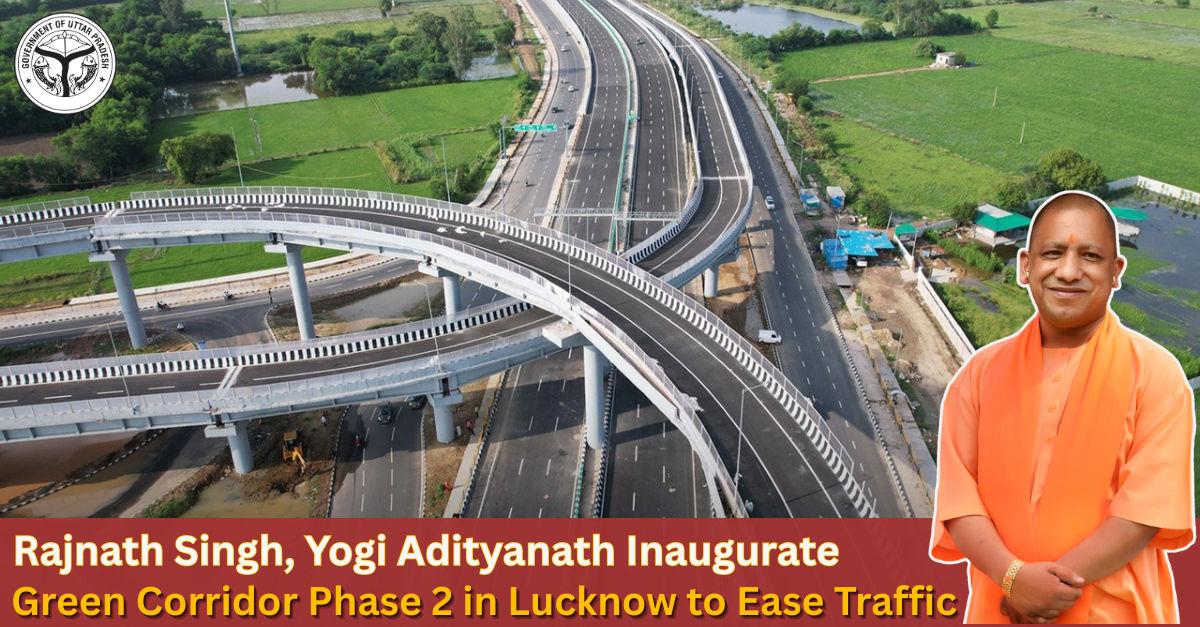
 Defence Minister Rajnath Singh and Uttar Pradesh Chief Minister Yogi Adityanath inaugurated the second phase of the Green Corridor project in Lucknow on Friday, marking a major step toward improving urban mobility and easing traffic congestion in the state capital. The newly opened stretch runs from Daliganj Pakka Pul to Samatamulak Chauraha and is expected to significantly reduce travel time for commuters moving across some of the city’s busiest areas.
The second phase of the project spans approximately seven kilometres and has been constructed at a cost of around ₹299 crore. Developed as part of a broader plan to modernise the city’s transport infrastructure, the corridor aims to streamline vehicular movement and reduce traffic pressure on key junctions that frequently experience congestion. With the inauguration of this stretch, residents are expected to experience smoother connectivity between several central and eastern parts of Lucknow.
During the inauguration ceremony, the two leaders also laid the foundation stones for the third and fourth phases of the Green Corridor project. These upcoming phases are estimated to cost about ₹1,220 crore and will further expand the corridor’s reach, strengthening the city’s road network. The next phases will extend the corridor from Samatamulak Chauraha toward Shaheed Path and eventually connect it to Kisan Path, creating a longer and more efficient traffic route across the city.
Speaking at the event, Chief Minister Yogi Adityanath congratulated the residents of Lucknow and highlighted the city’s transformation into a modern urban centre. He stated that the state capital has increasingly begun to reflect the spirit of the well-known phrase “Muskuraiye, aap Lucknow mein hain.” According to him, the aim of developing modern connectivity infrastructure is to make daily life more convenient for citizens and ensure that people can reach their destinations quickly and safely.
The chief minister also emphasised that once fully operational, the Green Corridor will bring a significant change to Lucknow’s traffic system. Earlier, commuters travelling along certain routes often took between 45 minutes and an hour to reach their destinations due to heavy traffic. With the corridor now operational in phases, the same journey could take only 10 to 15 minutes, offering major time savings and reducing congestion across key city roads.
Another notable aspect of the project is the funding model used for its development. Adityanath said the project was executed without requiring a separate budget allocation. Instead, the Lucknow Development Authority generated resources by reclaiming government land from encroachments and utilising it strategically. This approach allowed the authorities to complete the larger ₹1,519-crore project through improved resource management and planning.
Officials noted that the Green Corridor will ultimately form a major transport spine for the city. When fully developed, the nearly 28-kilometre corridor is expected to connect IIM Road to Pakka Pul in Daliganj and continue through Samatamulak Chauraha toward Pipraghat, Shaheed Path and further to Kisan Path. This long corridor will help create a faster east-west route across Lucknow, benefiting thousands of daily commuters and reducing pressure on existing arterial roads.
Infrastructure experts and city planners believe the project will not only improve commuting conditions but also support Lucknow’s long-term urban expansion. By improving traffic flow and connectivity between residential, commercial and institutional zones, the corridor is expected to enhance overall mobility in the city and support future development.
With Phase 2 now operational and the next stages already announced, the Green Corridor project is emerging as one of the key infrastructure initiatives shaping Lucknow’s modern transport landscape. Authorities say that once the remaining phases are completed, the corridor will play a crucial role in reducing traffic congestion and improving connectivity for residents across the rapidly growing state capital.